

Who Owns Gossip Now?
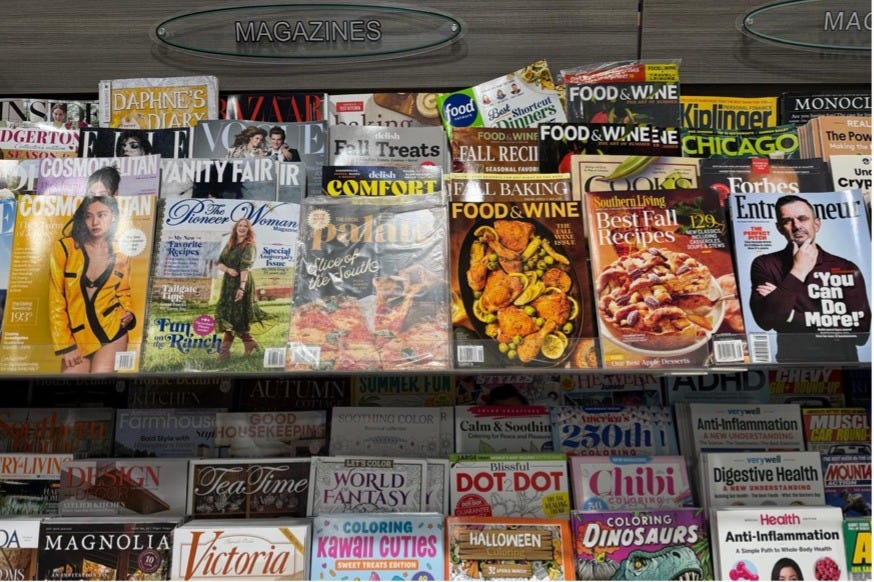
For generations, the American supermarket checkout was also a newsstand.
Waiting to pay for groceries meant staring at a wall of celebrity faces. Marriages were collapsing. Stars were gaining weight, losing weight, having babies, fighting with relatives or supposedly preparing for divorce. The headlines were enormous, the photographs unavoidable and the stories often based on unnamed sources.
Millions of copies were sold.
That world is disappearing.
In 2025, In Touch Weekly and Life & Style ended their print editions after their owner said it had been unable to develop a profitable business model for the titles. Other familiar names survive. Us Weekly is still published, as is Star. But the economics of the old supermarket model have changed dramatically.
A single copy of Us Weekly can now cost $7.99.
The price tells part of the story. Printing and distribution are expensive. Advertising has migrated elsewhere. Circulation has fallen. And a weekly magazine faces a problem no clever cover line can solve: Speed.
By the time a celebrity scandal has been reported, edited, printed, transported and placed beside a supermarket cash register, the same story may already have spent days circulating through Instagram, TikTok, YouTube and hundreds of other accounts.
It may already be old gossip.
But that does not mean Americans have lost their appetite for it.
Quite the opposite.
THE DEATH OF PRINT
The decline did not happen overnight.
At their peak, America’s celebrity magazines and supermarket tabloids commanded enormous audiences. They employed reporters, editors, photographers and paparazzi. They competed fiercely for exclusives and paid extraordinary attention to the private lives of celebrities.
The internet first challenged that model. Social media then attacked its greatest weakness: the time between discovering something and publishing it.
A printed weekly could never win that race.
In Touch and Life & Style were among the casualties. Their print editions disappeared in 2025 after years in which the economics of celebrity publishing became increasingly difficult.
Us Weekly and Star remain, but surviving is not the same as dominating.
The supermarket checkout once gave a handful of publishers enormous power over American celebrity culture.
That power has moved.
EVERYONE BECAME A PAPARAZZO
One name illustrates the transformation particularly well: DeuxMoi.
The anonymous celebrity-gossip account became popular by asking ordinary people to report what they saw. A celebrity walks into a restaurant. Someone recognizes the star. A phone comes out. A message is sent.
And potentially an enormous audience can know about the sighting before dessert arrives.
DeuxMoi built its reputation around anonymous submissions ranging from mundane celebrity sightings to claims about Hollywood affairs. The platform now extends beyond Instagram into TikTok, podcasts, a website and other products.
The technological change is deceptively simple. The old tabloid sent photographers out to find celebrities. The new gossip economy has millions of potential photographers already carrying cameras in their pockets.
The witness became the source. The audience became the distribution network.
Traditional tabloids were hardly models of perfect journalism. But behind them stood an identifiable publication, editor and owner.
In today’s digital gossip economy, the person who starts a rumor may be impossible for the audience to identify.
THE CREATOR TOOK THE NEWSROOM
The influencer became a media company.
The United States now has a creator economy in which individuals on YouTube, TikTok, Instagram and other platforms can build audiences once available only to television networks, magazines and major publishers.
By 2024, the number of U.S. creators had grown to more than 1.5 million. U.S. social-media influencer revenue is projected to reach roughly $21 billion in 2026.
At the top, Forbes reported that its 50 leading creators collectively generated more than $1 billion in earnings in 2026.
These are no longer simply people posting videos from bedrooms. Some operate production companies, employ teams, sell products and create programming watched by millions.
Celebrity culture is perfect material. A creator does not need to wait a week to discuss a breakup, red-carpet incident or celebrity feud. The video can be online within minutes and the audience can respond immediately.
The old tabloid published the story.
The creator economy publishes the story, and the reaction to it.
THE CELEBRITY BECAME THE PUBLISHER
There is another reason the traditional celebrity magazine has lost power.
Celebrities no longer need it as much.
For decades, stars and their publicists had a complicated relationship with the celebrity press. A magazine cover could introduce a new romance, promote a movie, repair a reputation or place a carefully managed version of a private story before millions of readers.
Today, the celebrity has a publishing platform.
Instagram can reveal the wedding. TikTok can show the new relationship. YouTube can provide the explanation. A podcast can tell the celebrity’s side of a controversy without a reporter asking an unwanted question.
The public figure can control the photograph, timing and wording.
That does not eliminate traditional entertainment journalism. Interviews, reporting and independent verification still matter.
But it changes the balance of power.
A celebrity once needed access to the media.
Today, many celebrities are media.
The gatekeeper has lost the gate.
CONCLUDING ANALYSIS: GOSSIP DIDN’T DIE
This is the contradiction at the heart of the collapse of America’s print tabloids.
The product is disappearing. The behavior is flourishing.
America did not abandon celebrity gossip when it stopped buying millions of supermarket magazines. Gossip escaped from the magazine.
It became instantaneous, participatory and algorithmic.
A handful of publishers has been replaced by an ecosystem containing celebrity websites, anonymous aggregators, TikTok commentators, YouTubers, podcasters, fan accounts, publicists, celebrities and millions of people carrying smartphones.
There are advantages.
Celebrities can correct false information directly. Audiences no longer depend on a handful of publishers to decide which stories matter. New independent creators can challenge established media narratives.
But there is also a price.
Speed rewards being first. Algorithms reward attention. Rumor can travel before verification catches up.
And when the original source is anonymous, responsibility becomes much harder to locate.
The American tabloid may therefore not have died at all.
Perhaps it simply stopped being a magazine.
BY THE NUMBERS
$7.99: Current single-copy cover price listed for Us Weekly.
2025: The year In Touch and Life & Style ended their print editions.
1.5+ million: U.S. content creators by 2024, according to a Reuters Breakingviews analysis.
$21 billion: Projected U.S. social-media influencer revenue in 2026.
$1+ billion: Combined 2026 earnings reported for Forbes’ 50 Top Creators.
THE QUESTION FOR TOMORROW
When everyone can be a tabloid, who is responsible for the truth?
The supermarket tabloid had an owner, an editor and an address.
The digital rumor can have millions of readers before anyone knows where it came from.
The future of gossip is no longer really a question about magazines. It is a question about accountability.
IN FOCUS: DEUXMOI
It began as an anonymous Instagram account and developed into something much larger: a celebrity-gossip ecosystem built around audience participation.
DeuxMoi invites anonymous tips and celebrity sightings and operates across multiple digital platforms.
Its success demonstrates perhaps the biggest structural change of all.
The traditional tabloid needed people to buy the publication. The digital gossip platform needs people to become part of the publication.
Every restaurant customer, hotel guest or passerby carrying a smartphone can potentially become a source.
The paparazzi did not disappear. They multiplied.
JOIN TOMORROW’S JOURNAL
Independent journalism. Analysis beyond the headline.
Or subscribe via hello@kriekmedia.com