

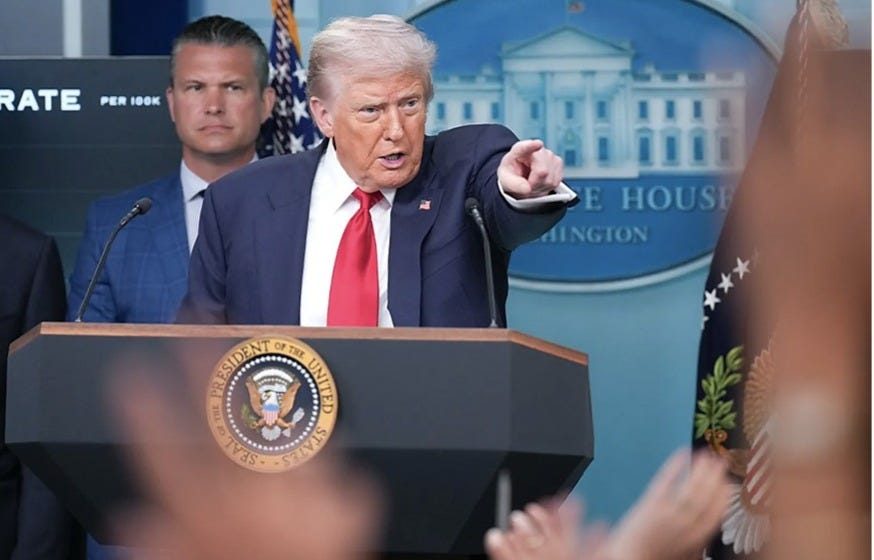
Who Controls the White House Press Room?
WASHINGTON: For six days, three major American news organizations found themselves on the wrong side of the White House gates.
President Donald Trump barred CNN, MS NOW and Politico after accusing them of publishing false reporting. Their journalists’ credentials were revoked.
The organizations went to court.
U.S. District Judge Timothy Kelly ordered the White House to restore their access for 14 days, finding that the organizations were likely to succeed in showing that their due-process rights had been violated.
But the confrontation did not immediately end.
Reporters attempting to enter the White House on Thursday morning were initially turned away despite the court order. The organizations returned to court. Hours later, journalists from all three organizations were again admitted to the White House grounds.
The dispute reaches beyond three news organizations.
Every White House must organize access to a president. Space is limited. Press pools exist because every reporter and television camera cannot accompany the president everywhere.
But organization is not the same as editorial control.
The distinction matters because access itself has become part of presidential communications strategy. A reporter who cannot enter cannot ask a question. A reporter who is admitted still decides what to ask. And a president who agrees to take questions still decides how, or whether, to answer them.
Those are separate powers. When they are treated as one, press management can become press control.
That distinction confronted previous administrations too.
During Joe Biden’s presidency, photographs revealed briefing cards identifying reporters who might be called upon, sometimes including their photographs, a question number and subjects the White House expected them to raise.
Those images prompted accusations that questions had been supplied in advance. But the evidence was more complicated. Preparing for likely questions and selecting reporters in advance did not by themselves establish that journalists had supplied their exact questions beforehand.
The Trump White House presents a different test.
Trump frequently answers reporters in less structured settings, including the Oval Office, where journalists can question the president at close range. Yet his administration has also asserted greater authority over who receives White House access and how presidential press pools are organized.
These are different forms of control.
A president can prepare.
A press office can organize.
A reporter can be selected.
But who controls the question?
That is where presidential message management meets independent journalism.
And it is why the fight over three White House press passes is about considerably more than three press passes.
THE BAN
Trump barred CNN, MS NOW and Politico after criticizing their coverage and accusing them of spreading false information. The organizations challenged the decision in federal court.
Judge Timothy Kelly temporarily ordered their credentials restored for 14 days. He found that they were likely to succeed on their claim that their due-process rights had been violated.
The journalists were initially turned away Thursday morning despite the order. Hours later, they were admitted again.
The court has not finally resolved the broader constitutional dispute. Further proceedings are expected.
The episode therefore leaves a question extending far beyond CNN, MS NOW and Politico:
What rules should determine who gets access to the President of the United States?
THE BIDEN CARDS
During Joe Biden’s presidency, photographers captured briefing cards containing the names and photographs of journalists expected to be called upon.
Some included anticipated subjects.
One widely circulated card identified ABC News correspondent Mary Bruce as “Question #3” and listed possible subjects involving the 2024 election and the debt limit.
Such cards demonstrate extensive preparation and, in some instances, an anticipated order of reporters.
They do not automatically prove that a journalist supplied an exact question beforehand.
That distinction matters.
Presidents have every reason to prepare for difficult questions. Their staffs are expected to anticipate them.
The journalistic boundary is crossed when preparation becomes control over what the reporter is permitted to ask.
THE TRUMP METHOD
Trump often operates differently.
Reporters regularly question him in the Oval Office and other settings where exchanges can be immediate and unpredictable.
That can produce extensive access. It can also make presidential message discipline more difficult.
At the same time, the Trump administration has asserted greater control over the structure of White House press access. The dispute involving CNN, MS NOW and Politico demonstrates how consequential that authority can become.
The two characteristics can coexist.
A president can answer spontaneous questions while his administration simultaneously exercises considerable influence over who gets close enough to ask them.
That distinction is central to the current dispute.
THE KMP METHOD
Professional preparation does not require controlling journalism.
Kriek Media Positioning separates three things:
Preparation. Selection. Control.
A president, CEO or public official should know the subject, establish the principal message and prepare for the hardest questions likely to come.
A press office should organize the event.
The journalist determines the question.
Trying to eliminate difficult questions can itself become the story. An unprepared answer can do the same.
The objective is therefore not to control the reporter.
It is to prepare the person facing the reporter.
Prepare the president. Organize the press conference. Never try to control the question. Control the answer.
CONCLUDING ANALYSIS: ACCESS IS POWER
The White House press dispute exposes two kinds of power.
The president has enormous influence over access. Journalists have enormous power over questions.
Neither relationship works without rules.
The Biden cards demonstrate how far presidential preparation can extend. The Trump dispute demonstrates how consequential control over access can become.
But preparation, selection and control are not interchangeable.
A government needs to organize presidential access. A president needs preparation. Journalists need independence to ask questions the government may not want to answer.
The present court case has temporarily restored access. It has not finally resolved where the constitutional boundary lies.
That boundary matters because a presidential press conference is not merely an event organized by government.
It is one of the places where government must face questions it did not write.
BY THE NUMBERS
3: News organizations at the center of the access dispute.
14 days: Temporary court order restoring access.
6 days: Without White House access before reinstatement.
3: Key distinctions: preparation, selection, control.
THE QUESTION FOR TOMORROW
IF THE PRESIDENT CAN CHOOSE WHO GETS IN, WHO PROTECTS THE QUESTIONS HE DOESN’T WANT TO HEAR?
IN FOCUS
WHO CONTROLS WHAT?
THE WHITE HOUSE
Event format, access, press logistics, presidential preparation.
THE JOURNALIST
The question, the follow-up, editorial judgment, what gets reported.
JOIN TOMORROW’S JOURNAL
Independent journalism. Analysis beyond the headline.
Or subscribe via hello@kriekmedia.com