

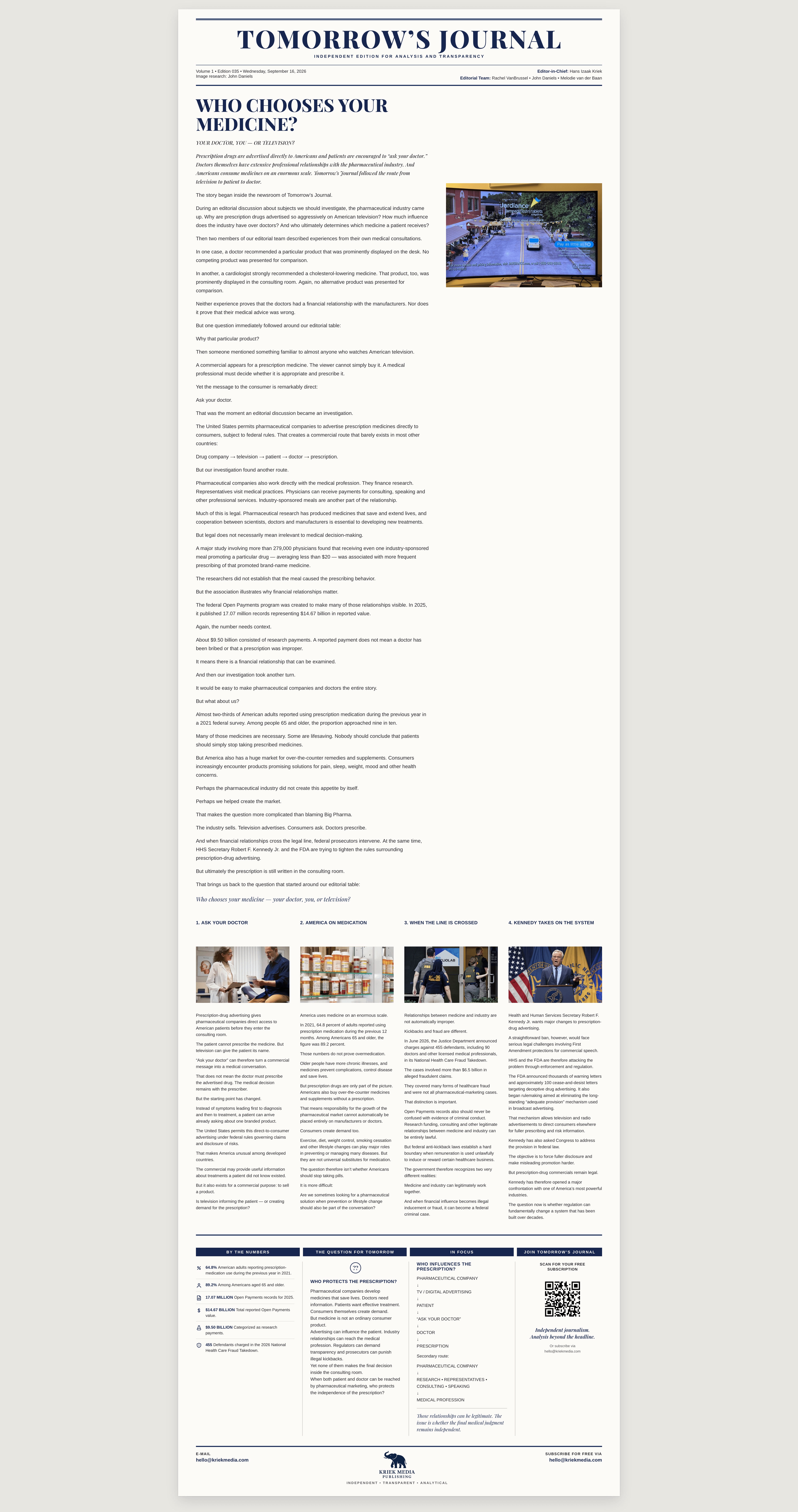
Who Chooses Your Medicine?
Prescription drugs are advertised directly to Americans and patients are encouraged to “ask your doctor.” Doctors themselves have extensive professional relationships with the pharmaceutical industry. And Americans consume medicines on an enormous scale. Tomorrow’s Journal followed the route from television to patient to doctor.
The story began inside the newsroom of Tomorrow’s Journal.
During an editorial discussion about subjects we should investigate, the pharmaceutical industry came up. Why are prescription drugs advertised so aggressively on American television? How much influence does the industry have over doctors? And who ultimately determines which medicine a patient receives?
Then two members of our editorial team described experiences from their own medical consultations.
In one case, a doctor recommended a particular product that was prominently displayed on the desk. No competing product was presented for comparison.
In another, a cardiologist strongly recommended a cholesterol-lowering medicine. That product, too, was prominently displayed in the consulting room. Again, no alternative product was presented for comparison.
Neither experience proves that the doctors had a financial relationship with the manufacturers. Nor does it prove that their medical advice was wrong.
But one question immediately followed around our editorial table:
Why that particular product?
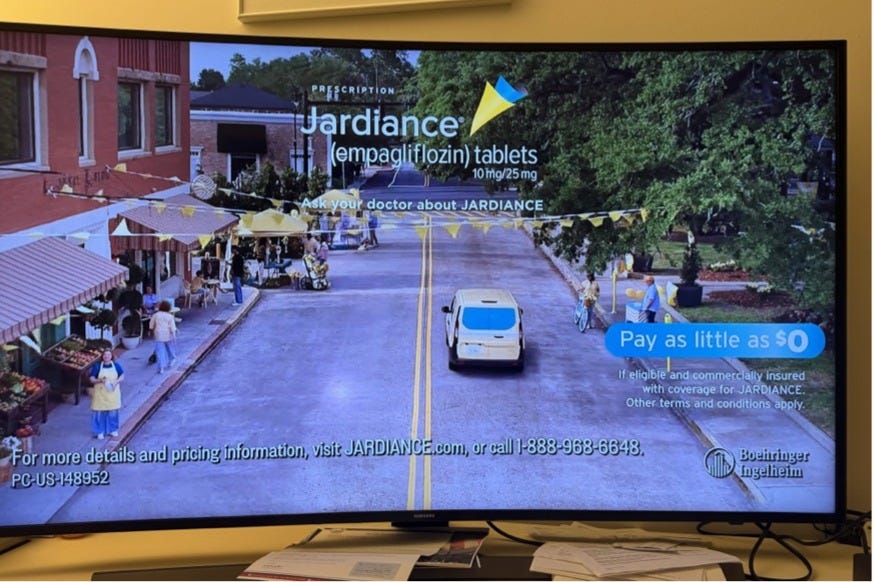
Then someone mentioned something familiar to almost anyone who watches American television.
A commercial appears for a prescription medicine. The viewer cannot simply buy it. A medical professional must decide whether it is appropriate and prescribe it.
Yet the message to the consumer is remarkably direct:
Ask your doctor.
That was the moment an editorial discussion became an investigation.
The United States permits pharmaceutical companies to advertise prescription medicines directly to consumers, subject to federal rules. That creates a commercial route that barely exists in most other countries:
Drug company → television → patient → doctor → prescription.
But our investigation found another route.
Pharmaceutical companies also work directly with the medical profession. They finance research. Representatives visit medical practices. Physicians can receive payments for consulting, speaking and other professional services. Industry-sponsored meals are another part of the relationship.
Much of this is legal. Pharmaceutical research has produced medicines that save and extend lives, and cooperation between scientists, doctors and manufacturers is essential to developing new treatments.
But legal does not necessarily mean irrelevant to medical decision-making.
A major study involving more than 279,000 physicians found that receiving even one industry-sponsored meal promoting a particular drug (averaging less than $20) was associated with more frequent prescribing of that promoted brand-name medicine.
The researchers did not establish that the meal caused the prescribing behavior.
But the association illustrates why financial relationships matter.
The federal Open Payments program was created to make many of those relationships visible. In 2025, it published 17.07 million records representing $14.67 billion in reported value.
Again, the number needs context.
About $9.50 billion consisted of research payments. A reported payment does not mean a doctor has been bribed or that a prescription was improper.
It means there is a financial relationship that can be examined.
And then our investigation took another turn.
It would be easy to make pharmaceutical companies and doctors the entire story.
But what about us?
Almost two-thirds of American adults reported using prescription medication during the previous year in a 2021 federal survey. Among people 65 and older, the proportion approached nine in ten.
Many of those medicines are necessary. Some are lifesaving. Nobody should conclude that patients should simply stop taking prescribed medicines.
But America also has a huge market for over-the-counter remedies and supplements. Consumers increasingly encounter products promising solutions for pain, sleep, weight, mood and other health concerns.
Perhaps the pharmaceutical industry did not create this appetite by itself.
Perhaps we helped create the market.
That makes the question more complicated than blaming Big Pharma.
The industry sells. Television advertises. Consumers ask. Doctors prescribe.
And when financial relationships cross the legal line, federal prosecutors intervene. At the same time, HHS Secretary Robert F. Kennedy Jr. and the FDA are trying to tighten the rules surrounding prescription-drug advertising.
But ultimately the prescription is still written in the consulting room.
That brings us back to the question that started around our editorial table:
ASK YOUR DOCTOR
Prescription-drug advertising gives pharmaceutical companies direct access to American patients before they enter the consulting room.
The patient cannot prescribe the medicine. But television can give the product its name.
“Ask your doctor” can therefore turn a commercial message into a medical conversation.
That does not mean the doctor must prescribe the advertised drug. The medical decision remains with the prescriber.
But the starting point has changed.
Instead of symptoms leading first to a doctor, and then to treatment, a patient can arrive already asking about one branded product.
The United States permits this direct-to-consumer advertising under federal rules governing claims and disclosure of risks.
That makes America unusual among developed countries.
The commercial may provide useful information about treatments a patient did not know existed.
But it also exists for a commercial purpose: to sell a product.
Is television informing the patient, or creating demand for the prescription?
AMERICA ON MEDICATION
America uses medicine on an enormous scale.
In 2021, 64.8 percent of adults reported using prescription medication during the previous 12 months. Among Americans 65 and older, the figure was 89.2 percent.
Those numbers do not prove overmedication. Older people have more chronic illnesses, and medicines prevent complications, control disease and save lives.
But prescription drugs are only part of the picture. Americans also buy over-the-counter medicines and supplements without a prescription.
That means measuring the full size of the pharmaceutical market cannot automatically be placed only on manufacturers or doctors.
Consumers create demand too.
Exercise, diet, weight control, smoking cessation and other lifestyle changes can play major roles in preventing or managing many diseases. But they are not universal substitutes for medication.
The question therefore isn’t whether Americans should stop taking pills.
It is more difficult.
Are we sometimes looking for a pharmaceutical solution when prevention or lifestyle change should be part of the conversation?
WHEN THE LINE IS CROSSED
Relationships between medicine and industry are not automatically improper.
Kickbacks and fraud are different.
In June 2025, the Justice Department announced charges against 455 defendants, including 96 doctors and other licensed medical professionals, in its National Health Care Fraud Takedown.
The cases involved more than $14.6 billion in alleged fraudulent claims.
They covered many forms of healthcare fraud and were not all pharmaceutical-marketing cases.
That distinction is important.
Open Payments records also should never be confused with evidence of criminal conduct. Research funding, consulting and other legitimate relationships between medicine and industry can be entirely lawful.
But federal anti-kickback laws establish a hard boundary when remuneration is used unlawfully to induce or reward certain healthcare business.
The government therefore recognizes two very different realities:
Medicine and industry can legitimately work together.
And when financial influence becomes illegal inducement or fraud, it can become a criminal case.
KENNEDY TAKES ON THE SYSTEM
Health and Human Services Secretary Robert F. Kennedy Jr. wants major changes to prescription-drug advertising.
A straightforward ban, however, would raise serious legal challenges involving First Amendment protections for commercial speech.
HHS and the FDA are therefore attacking the problem through enforcement and regulation.
The FDA has announced thousands of warning letters and approximately 100 cease-and-desist letters targeting deceptive drug advertising. It also began rulemaking aimed at eliminating the long-standing “adequate provision” mechanism used in broadcast advertising.
That mechanism allows television and radio advertisements to direct consumers elsewhere for fuller prescribing and risk information.
Kennedy has also asked Congress to address the provision in federal law.
The objective is to force fuller disclosure and make misleading promotion harder.
But prescription-drug commercials remain legal.
Kennedy has therefore opened a major confrontation with one of America’s most powerful industries.
The question now is whether regulation can fundamentally change a system that has been built over decades.
BY THE NUMBERS
64.8%: American adults reporting prescription medication use during the previous year in 2021.
89.2%: Among Americans aged 65 and older.
17.07 million: Open Payments records for 2025.
$14.67 billion: Total reported Open Payments value.
$9.50 billion: Categorized as research payments.
455: Defendants charged in the 2025 National Health Care Fraud Takedown
THE QUESTION FOR TOMORROW
WHO PROTECTS THE PRESCRIPTION?
Pharmaceutical companies develop medicines that save lives. Doctors need information. Patients want effective treatment. Consumers themselves create demand. But medicine is not an ordinary consumer product.
Advertising can influence the patient, industry relationships can reach the medical profession. Regulations can demand transparency and prosecutors can punish illegal kickbacks.
Yet none of them makes the final decision inside the consulting room.
When both patient and doctor can be reached by pharmaceutical marketing, who protects the independence of the prescription?
IN FOCUS
WHO INFLUENCES THE PRESCRIPTION?
Pharmaceutical Company → TV/Digital Advertising → Patient → “Ask your doctor” → Doctor → Prescription
Pharmaceutical Company → Research + Representatives + Consulting + Speaking → Medical Profession
Those relationships can be legitimate. The issue is whether the final medical judgment remains independent.
JOIN TOMORROW’S JOURNAL
Independent journalism. Analysis beyond the headline.
Or subscribe via hello@kriekmedia.com