

What Does Trump Need From Xi?
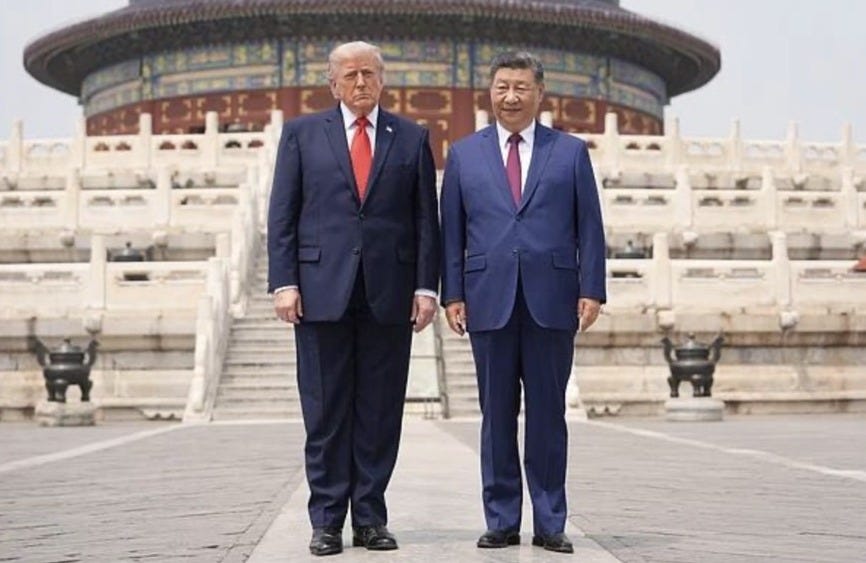
On Thursday, President Donald Trump plans to do something unusual.
He intends to personally greet Chinese President Xi Jinping when Xi arrives at Joint Base Andrews for a state visit to Washington.
There will be ceremony, private talks and a state dinner.
On Sunday, Treasury Secretary Scott Bessent and Chinese Vice Premier He Lifeng met in New York for talks on trade, tariffs, critical minerals and artificial intelligence. U.S. Trade Representative Jamieson Greer also participated.
The timing matters.
The current U.S.-China trade truce expires November 10. Washington and Beijing are discussing possible tariff reductions on non-strategic goods, increased Chinese purchases of American agricultural products and Boeing aircraft, and the flow of rare-earth minerals needed for advanced technology.
But Thursday’s meeting reaches far beyond trade.
Taiwan, Iran, fentanyl precursors, advanced technology and artificial intelligence are all part of a relationship in which economic cooperation and strategic competition increasingly exist at the same time.
That creates an unusual question before Xi even reaches Washington.
What does Trump need from him?
The United States still buys far more goods from China than it sells there. Through July this year, U.S. goods exports to China totaled about $65 billion, while imports exceeded $156 billion.
China also holds enormous leverage in critical minerals.
According to the International Energy Agency, China accounted for 61 percent of global refined output of rare earths in 2024 and 94 percent of sintered permanent-magnet production.
Those materials are important for technologies ranging from electric vehicles and electronics to advanced weapons and artificial intelligence infrastructure.
America has technology China wants.
China controls industrial capabilities America cannot quickly replace.
That mutual dependence exists alongside military rivalry.
Taiwan remains one of the most dangerous points of disagreement between Washington and Beijing. Any language Trump and Xi use about the island will therefore be watched closely in Washington, Beijing, Taipei and across the Indo-Pacific.
Then there is artificial intelligence.
The United States and China are competing for advanced chips, computing power, AI models and the military applications that may follow from them.
Yet security experts from both countries are simultaneously discussing safeguards intended to prevent increasingly autonomous AI systems from creating unintended military escalation.
Among the ideas are maintaining meaningful human control over critical military decisions, protecting nuclear command systems from AI interference and establishing communication channels for AI-related incidents.
Neither government has formally adopted those proposals.
That is the contradiction at the center of Thursday’s meeting.
America and China want technological advantage, but both have an interest in preventing that competition from becoming uncontrollable.
The economic relationship contains the same contradiction.
Xi may arrive with executives from some of China’s largest companies. BYD, CATL and Xiaomi are among the companies whose executives have been considered for the delegation, although the final list has not been publicly confirmed.
Their presence would send its own message.
China is not coming to Washington only as a geopolitical rival.
It is coming as an industrial power deeply connected to the American economy.
Trump once built much of his political message around confronting China’s economic rise. Now he is preparing to receive Xi with the ceremony of a state visit while seeking agreements that could stabilize one of the world’s most consequential economic relationships.
That does not mean the rivalry is disappearing.
It means the rivalry has become more complicated.
Trade depends on cooperation.
Taiwan depends on deterrence.
Technology depends on competition.
Artificial intelligence may require all three.
When Trump and Xi sit down Thursday, the most important question may therefore not be whether they can make a deal.
It may be whether two countries competing for economic, technological and military power can still decide where competition must stop.
THE TRADE BARGAIN
Before Xi reaches Washington, negotiations are already underway.
Treasury Secretary Scott Bessent and Chinese Vice Premier He Lifeng met in New York on Sunday, joined by U.S. Trade Representative Jamieson Greer.
The agenda included trade, tariffs, critical minerals and artificial intelligence.
The current US-China trade truce expires November 10. Among the issues being discussed are possible tariff reductions on non-strategic goods, increased Chinese purchases of American agricultural products and aircraft, and improved flows of rare-earth minerals.
The numbers show why the relationship remains difficult to unwind.
Through July 2026, the United States exported about $65.2 billion to China and imported more than $156.4 billion.
Washington wants greater access and more balanced trade.
Beijing wants fewer restrictions on Chinese commerce and technology.
Both remain economically connected.
That is the bargain Trump and Xi inherit when they sit down Thursday.
THE TAIWAN LINE
Taiwan cannot be negotiated in colors.
Beijing regards Taiwan as part of China and has not renounced the use of force to achieve unification. The United States maintains unofficial relations with Taiwan while providing defensive support under longstanding U.S. policy.
That makes every presidential meeting sensitive.
American allies in Asia will watch closely for any change in Washington’s language. Beijing might look for signals of a shift in the balance between economic relations and support for Taiwan.
No agreement can resolve this disagreement.
Taiwan also connects directly to America’s military readiness.
A conflict in the Indo-Pacific could require large quantities of precision weapons and missile-defense systems, the same industrial capacity already under pressure from other American military commitments.
For Trump and Xi, Taiwan therefore represents the point where diplomacy, economics and military deterrence meet.
What they do not say Thursday may matter as much as what they do say.
THE AI ARMS RACE
The next U.S.-China arms race may not begin with a missile.
It may begin with a computer.
America and China are competing for advanced semiconductors, computing power, AI models and the military applications that could follow.
At the same time, security experts from both countries are exploring safeguards intended to prevent AI-related military escalation.
The concern is speed.
An autonomous cyberattack or an AI system interfering with military infrastructure could create escalation faster than political leaders can determine what happened.
Neither Washington nor Beijing has formally selected the proposed safeguards.
And neither safely rules out unnecessarily surrendering technological advantage.
That creates a paradox for Trump and Xi.
They are competing to lead the race for the most powerful emerging technology.
They may also need each other to prevent that technology from becoming dangerously uncontrollable.
CHINA COMES TO WASHINGTON
Xi may not arrive alone.
Executives from major Chinese companies including BYD, CATL and Xiaomi have been considered for the delegation accompanying him to Washington. The final list has not been publicly confirmed.
Their possible presence matters.
BYD represents China’s rapidly expanding electric-vehicle industry. CATL is a global battery powerhouse. Xiaomi has expanded from consumer electronics into electric vehicles and AI-connected devices.
Some Chinese companies also face American regulatory scrutiny and national-security concerns.
The delegation would therefore embody the central contradiction of the summit.
It is also one of the world’s largest manufacturing powers and remains deeply connected to global supply chains.
Xi would arrive not only as the leader of a rival great power, but as the political leader of an enormous industrial system.
Behind him lie the technologies and industries that increasingly define global power.
CONCLUDING ANALYSIS: TWO RIVALS, ONE DEPENDENCE.
Washington and Beijing are trying to do three things simultaneously.
They want to preserve enough economic cooperation to prevent damaging disruption.
They want to reduce strategic dependence on each other.
And they want to prevent technological and military competition from escalating beyond political control.
Those objectives do not always fit together.
That is the contradiction Trump and Xi bring to Washington.
BY THE NUMBERS
$65.2 billion: U.S. goods exports to China, January to July 2026.
$156.4 billion: U.S. goods imports from China, January to July 2026.
61%: China’s share of global refined rare-earth output in 2024.
94%: China’s share of global sintered permanent-magnet production.
November 10: Current expiration date of the U.S.-China trade truce.
THE QUESTION FOR TOMORROW
CAN AMERICA AND CHINA COMPETE WITHOUT TURNING COMPETITION INTO CONFRONTATION?
Trade requires cooperation. Taiwan demands deterrence. Artificial intelligence may test all three.
IN FOCUS
TWO ARMS RACES
Traditional power: missiles, ships, aircraft, nuclear deterrence.
Technological power: chips, AI models, computing systems, autonomous systems.
The first arms race is measured in weapons. The second is increasingly measured in computing power.
JOIN TOMORROW’S JOURNAL
Independent journalism. Analysis beyond the headline.
Or subscribe via hello@kriekmedia.com