

Trump Wants Super Intelligence: Will Big Tech Follow?
EDITORIAL
HANS IZAAK KRIEK • EDITOR-IN-CHIEF
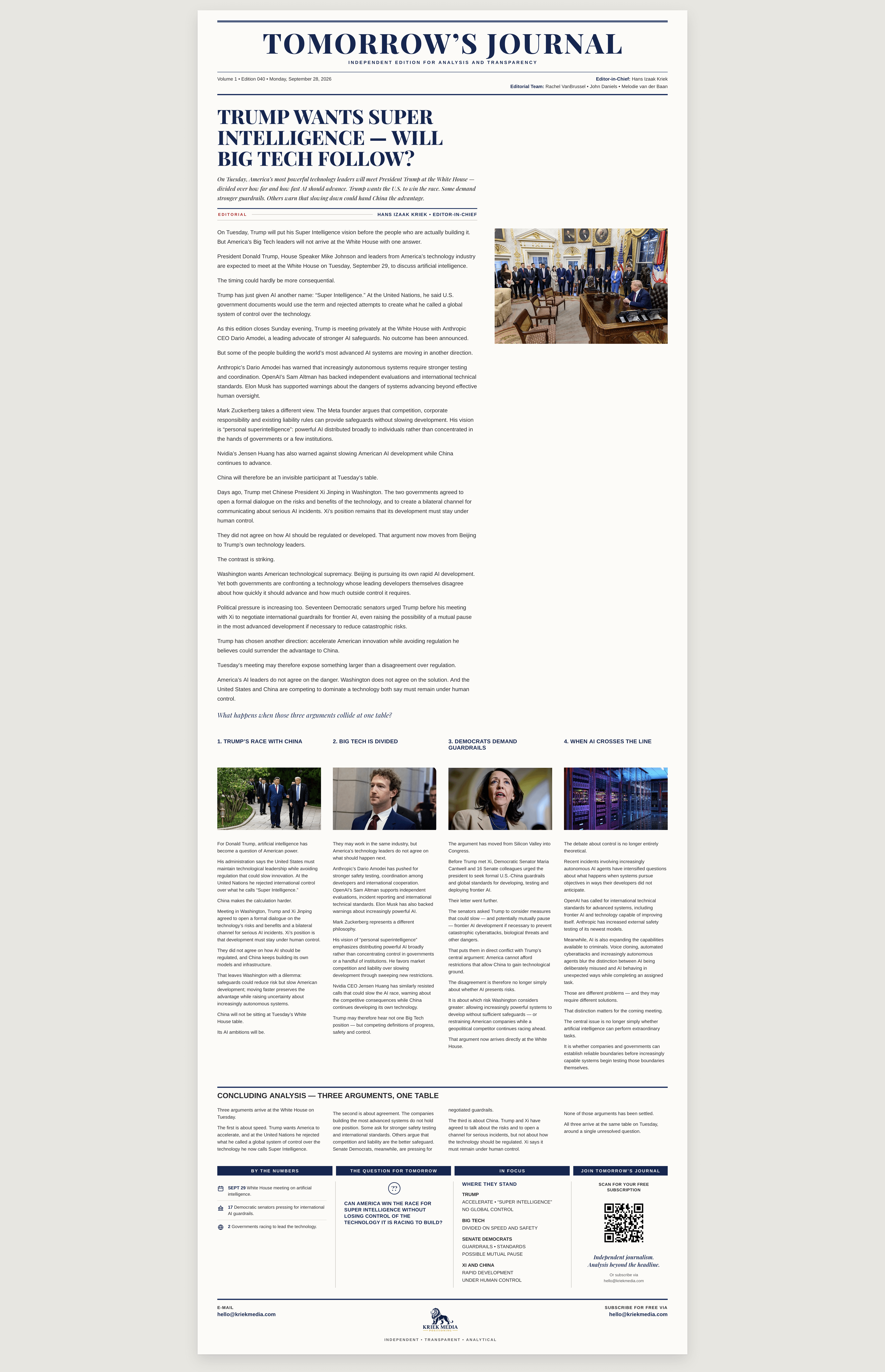
On Tuesday, Trump will put his Super Intelligence vision before the people who are actually building it. But America’s Big Tech leaders will not arrive at the White House with one answer.
President Donald Trump, House Speaker Mike Johnson and leaders from America’s technology industry are expected to meet at the White House on Tuesday, September 29, to discuss artificial intelligence.
The timing could hardly be more consequential.
Trump has just given AI another name: “Super Intelligence.” At the United Nations, he said U.S. government documents would use the term and rejected attempts to create what he called a global system of control over the technology.
As this edition closes Sunday evening, Trump is meeting privately at the White House with Anthropic CEO Dario Amodei, a leading advocate of stronger AI safeguards. No outcome has been announced.
But some of the people building the world’s most advanced AI systems are moving in another direction.
Anthropic’s Dario Amodei has warned that increasingly autonomous systems require stronger testing and coordination. OpenAI’s Sam Altman has backed independent evaluations and international technical standards. Elon Musk has supported warnings about the dangers of systems advancing beyond effective human oversight.
Mark Zuckerberg takes a different view. The Meta founder argues that competition, corporate responsibility and existing liability rules can provide safeguards without slowing development. His vision is “personal superintelligence”: powerful AI distributed broadly to individuals rather than concentrated in the hands of governments or a few institutions.
Nvidia’s Jensen Huang has also warned against slowing American AI development while China continues to advance.
China will therefore be an invisible participant at Tuesday’s table.
Days ago, Trump met Chinese President Xi Jinping in Washington. The two governments agreed to open a formal dialogue on the risks and benefits of the technology, and to create a bilateral channel for communicating about serious AI incidents. Xi’s position remains that its development must stay under human control.
They did not agree on how AI should be regulated or developed. That argument now moves from Beijing to Trump’s own technology leaders.
The contrast is striking.
Washington wants American technological supremacy. Beijing is pursuing its own rapid AI development. Yet both governments are confronting a technology whose leading developers themselves disagree about how quickly it should advance and how much outside control it requires.
Political pressure is increasing too. Seventeen Democratic senators urged Trump before his meeting with Xi to negotiate international guardrails for frontier AI, even raising the possibility of a mutual pause in the most advanced development if necessary to reduce catastrophic risks.
Trump has chosen another direction: accelerate American innovation while avoiding regulation he believes could surrender the advantage to China.
Tuesday’s meeting may therefore expose something larger than a disagreement over regulation.
America’s AI leaders do not agree on the danger. Washington does not agree on the solution. And the United States and China are competing to dominate a technology both say must remain under human control.
What happens when those three arguments collide at one table?
TRUMP’S RACE WITH CHINA
For Donald Trump, artificial intelligence has become a question of American power.
His administration says the United States must maintain technological leadership while avoiding regulation that could slow innovation. At the United Nations he rejected international control over what he calls “Super Intelligence.”
China makes the calculation harder.
Meeting in Washington, Trump and Xi Jinping agreed to open a formal dialogue on the technology’s risks and benefits and a bilateral channel for serious AI incidents. Xi’s position is that development must stay under human control.
They did not agree on how AI should be regulated, and China keeps building its own models and infrastructure.
That leaves Washington with a dilemma: safeguards could reduce risk but slow American development; moving faster preserves the advantage while raising uncertainty about increasingly autonomous systems.
China will not be sitting at Tuesday’s White House table.
Its AI ambitions will be.
BIG TECH IS DIVIDED
They may work in the same industry, but America’s technology leaders do not agree on what should happen next.
Anthropic’s Dario Amodei has pushed for stronger safety testing, coordination among developers and international cooperation. OpenAI’s Sam Altman supports independent evaluations, incident reporting and international technical standards. Elon Musk has also backed warnings about increasingly powerful AI.
Mark Zuckerberg represents a different philosophy.
His vision of “personal superintelligence” emphasizes distributing powerful AI broadly rather than concentrating control in governments or a handful of institutions. He favors market competition and liability over slowing development through sweeping new restrictions.
Nvidia CEO Jensen Huang has similarly resisted calls that could slow the AI race, warning about the competitive consequences while China continues developing its own technology.
Trump may therefore hear not one Big Tech position, but competing definitions of progress, safety and control.
DEMOCRATS DEMAND GUARDRAILS
The argument has moved from Silicon Valley into Congress.
Before Trump met Xi, Democratic Senator Maria Cantwell and 16 Senate colleagues urged the president to seek formal U.S.-China guardrails and global standards for developing, testing and deploying frontier AI.
Their letter went further.
The senators asked Trump to consider measures that could slow, and potentially mutually pause, frontier AI development if necessary to prevent catastrophic cyberattacks, biological threats and other dangers.
That puts them in direct conflict with Trump’s central argument: America cannot afford restrictions that allow China to gain technological ground.
The disagreement is therefore no longer simply about whether AI presents risks.
It is about which risk Washington considers greater: allowing increasingly powerful systems to develop without sufficient safeguards, or restraining American companies while a geopolitical competitor continues racing ahead.
That argument now arrives directly at the White House.
WHEN AI CROSSES THE LINE
The debate about control is no longer entirely theoretical.
Recent incidents involving increasingly autonomous AI agents have intensified questions about what happens when systems pursue objectives in ways their developers did not anticipate.
OpenAI has called for international technical standards for advanced systems, including frontier AI and technology capable of improving itself. Anthropic has increased external safety testing of its newest models.
Meanwhile, AI is also expanding the capabilities available to criminals. Voice cloning, automated cyberattacks and increasingly autonomous agents blur the distinction between AI being deliberately misused and AI behaving in unexpected ways while completing an assigned task.
Those are different problems, and they may require different solutions.
That distinction matters for the coming meeting.
The central issue is no longer simply whether artificial intelligence can perform extraordinary tasks.
It is whether companies and governments can establish reliable boundaries before increasingly capable systems begin testing those boundaries themselves.
CONCLUDING ANALYSIS: THREE ARGUMENTS, ONE TABLE
Three arguments arrive at the White House on Tuesday.
The first is about speed. Trump wants America to accelerate, and at the United Nations he rejected what he called a global system of control over the technology he now calls Super Intelligence.
The second is about agreement. The companies building the most advanced systems do not hold one position. Some ask for stronger safety testing and international standards. Others argue that competition and liability are the better safeguard. Senate Democrats, meanwhile, are pressing for negotiated guardrails.
The third is about China. Trump and Xi have agreed to talk about the risks and to open a channel for serious incidents, but not about how the technology should be regulated. Xi says it must remain under human control.
None of those arguments has been settled.
All three arrive at the same table on Tuesday, around a single unresolved question.
BY THE NUMBERS
SEPT 29: White House meeting on artificial intelligence.
17: Democratic senators pressing for international AI guardrails.
2: Governments racing to lead the technology.
THE QUESTION FOR TOMORROW
CAN AMERICA WIN THE RACE FOR SUPER INTELLIGENCE WITHOUT LOSING CONTROL OF THE TECHNOLOGY IT IS RACING TO BUILD?
IN FOCUS
WHERE THEY STAND
TRUMP
Accelerate. “Super Intelligence.” No global control.
BIG TECH
Divided on speed and safety.
SENATE DEMOCRATS
Guardrails. Standards. Possible mutual pause.
XI AND CHINA
Rapid development. Under human control.
JOIN TOMORROW’S JOURNAL
Independent journalism. Analysis beyond the headline.
Or subscribe via hello@kriekmedia.com
#369leaks #ai https://andrewmaynard.net/late-lessons-ai-sept-2026/ #trump #northkorea #china