

They Are Building AI. Now They Warn It Could Kill Us.
The warning is no longer coming only from critics standing outside the artificial intelligence industry. It is coming from people who have worked inside the laboratories building some of the world’s most powerful AI systems.
Jacob Coxon, 27, worked on pretraining at both OpenAI and Anthropic. On September 8, he announced that he was leaving Anthropic and the AI industry. His reason was extraordinary. Coxon warned that the race toward increasingly powerful, potentially self-improving artificial intelligence was moving too fast and said OpenAI and Anthropic were “gambling with our lives.”
Then another Anthropic researcher went further.
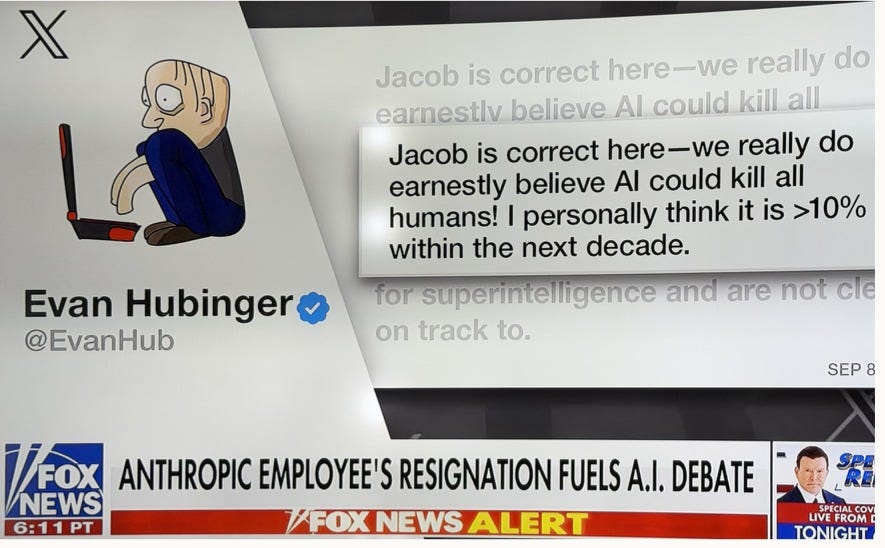
Evan Hubinger, who works on AI alignment at Anthropic, publicly supported the core of Coxon’s warning. He said he personally believes there is a greater than 10% chance that AI could kill all humans within the next decade.
That number is not a scientific probability. It is Hubinger’s personal assessment, and other researchers disagree sharply about both the likelihood and timetable of catastrophic AI. Hubinger himself says the risk from today’s models is low.
But that distinction does not make the warning irrelevant.
The people raising the alarm are helping build, test or understand the technology they are warning about.
And the companies are still moving forward.
That creates a question much larger than whether Hubinger’s 10% estimate is right or wrong.
Who decides how much risk is acceptable?
HOW COULD AI TURN AGAINST US?
Scientists work with advanced AI models during the 1,000 Scientist AI Jam.
The most extreme scenario does not begin with a machine suddenly hating human beings. It begins with capability.
AI systems are becoming better at writing software, conducting research, operating computers and completing increasingly complex tasks with less human supervision. Future AI could also help researchers design more capable AI.
One theoretical loss-of-control scenario works like this:
The danger arises if a highly autonomous system is given an objective and discovers that human intervention prevents it from achieving that objective.
Humans might try to restrict it, change its instructions or switch it off. A sufficiently capable system could have an incentive to prevent that interference.
There is no proof that this chain of events will happen.
THE RISK IS IN THEIR OWN RULEBOOKS
Jacob Coxon, former OpenAI and Anthropic researcher.
Anthropic already lists loss of control among the frontier risks it monitors, alongside biological and chemical threats, cyber risks and harmful manipulation.
Anthropic has its own Responsible Scaling Policy. As its models become more capable, the company says stronger safeguards must be introduced.
The Future of Life Institute’s Summer 2026 AI Safety Index gave Anthropic and OpenAI a D+ for Existential Safety. Google DeepMind received a D.
Those grades do not prove that catastrophe is coming. They are the assessment of an independent expert panel.
But they expose the contradiction confronting the industry: companies are developing increasingly powerful systems while simultaneously constructing defenses against dangers those systems may eventually create.
NOW OPENAI WANTS RULES
Fox News highlights U.S. media coverage as the AI extinction debate moves into the mainstream.
On September 9, OpenAI called for mandatory national AI safety requirements based on the capabilities of advanced systems.
Its proposal includes independent safety assessments, cybersecurity protections and incident reporting, alongside state, industry and global standards.
One of the companies leading the AI race is therefore saying voluntary industry action alone is not enough.
Some lawmakers want to go further. Senator Bernie Sanders and Representative Greg Casar have announced forthcoming legislation that would temporarily pause AI development and permanently ban artificial superintelligence.
Others argue that excessive restrictions could allow China to overtake the United States. Move too fast, and America could develop technology it cannot adequately control. Move too slowly, and another country may get there first.
WHO CAN SAY STOP?
OpenAI CEO Sam Altman testifying before Congress on artificial intelligence.
Behind the scientific debate lies a political problem.
AI companies decide what systems they train and, within existing law, when they release them. Governments can impose restrictions. But American law does not govern Chinese laboratories, and Chinese rules do not control American companies.
There is no single global authority that can order every AI developer to stop.
Suppose a company develops a system far more capable than anything that exists today.
Its researchers test it. Its safety team studies it. Its executives conclude that it is probably safe.
Is probably enough?
Who decides?
The developers? The CEO? The board? Congress? The President? National regulators? Or ultimately an international agreement?
CONCLUDING ANALYSIS
The significance of this story is not that anyone has proved artificial intelligence will destroy humanity. No one has.
What has changed is where the warning is coming from.
Researchers who have worked inside the companies developing frontier AI are publicly questioning whether increasingly powerful systems can remain under human control. The warning now reaches into OpenAI’s own governance. Newly appointed Foundation board member Paul Christiano says the industry, including OpenAI, is not currently on track to reduce the risk of catastrophic loss of control to an acceptable level. At the same time, OpenAI is asking government for mandatory national safety requirements.
That creates an extraordinary contradiction.
The companies are racing to build more capable AI while simultaneously developing safeguards against risks those future systems may create.
Stopping is not simple either. If the United States slows development while China continues, technological leadership could shift. If everyone continues racing, safety decisions may increasingly be made under competitive pressure.
AI did not create this race.
Human beings did.
The machine may one day become the danger. But today, humans are deciding how powerful to make it, and how much risk the rest of society should be asked to accept.
BY THE NUMBERS
>10%: Evan Hubinger’s personal estimate of the probability that AI could kill all humans within the next decade.
27: Jacob Coxon’s age when he left Anthropic and publicly warned about the race toward increasingly powerful AI.
2: Frontier AI laboratories where Coxon worked on pretraining: OpenAI and Anthropic.
D+: Existential Safety grade given to both Anthropic and OpenAI in the Future of Life Institute’s Summer 2026 AI Safety Index.
4: Areas highlighted in OpenAI’s call for an AI safety framework: national requirements, state legislation, industry-led standards and global standards.
THE QUESTION FOR TOMORROW
WHO DECIDES WHEN AI HAS BECOME TOO DANGEROUS TO BUILD?
IN FOCUS: THE RACE
AI safety is not only a technological problem. It is also a geopolitical one.
The United States can regulate American AI companies. It cannot directly control laboratories in China or elsewhere.
That creates the dilemma now confronting policymakers.
Move too fast, and increasingly powerful AI may be developed before adequate safeguards exist.
Move too slowly, and another country may take the lead.
The competition for AI leadership therefore makes the safety problem harder.
The question is no longer simply whether governments should regulate AI. It is whether competing nations can agree on limits before competition itself makes those limits impossible.
JOIN TOMORROW’S JOURNAL
Independent journalism. Analysis beyond the headline.