

FIFA World Cup 2026: The World’s Biggest Game or the World’s Biggest Business?
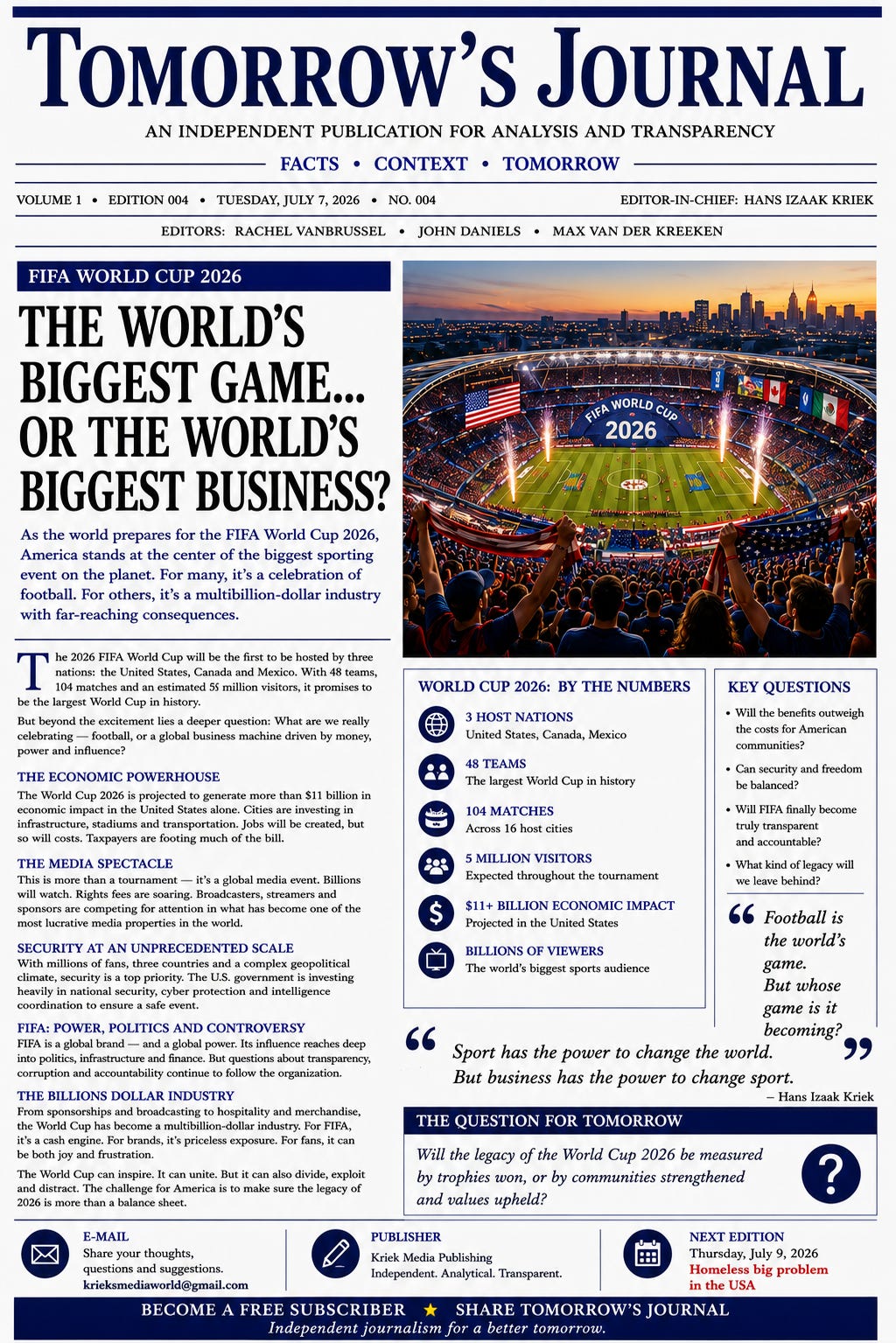
FIFA WORLD CUP 2026
The World’s Biggest Game… or the World’s Biggest Business?
As the world prepares for the FIFA World Cup 2026, America stands at the center of the biggest sporting event on the planet. For many, it’s a celebration of football. For others, it’s a multibillion-dollar industry with far-reaching consequences.
The 2026 FIFA World Cup will be the first to be hosted by three nations: the United States, Canada and Mexico. With 48 teams, 104 matches and an estimated 55 million visitors, it promises to be the largest World Cup in history.
But beyond the excitement lies a deeper question: What are we really celebrating, football, or a global business machine driven by money, power and influence?
The Economic Powerhouse
The World Cup 2026 is projected to generate more than $11 billion in economic impact in the United States alone. Cities are investing in infrastructure, stadiums and transportation. Jobs will be created, but so will costs. Taxpayers are footing much of the bill.
The Media Spectacle
This is more than a tournament. It’s a global media event. Billions will watch. Rights fees are soaring. Broadcasters, streamers and sponsors are competing for attention in what has become one of the most lucrative media properties in the world.
Security at an Unprecedented Scale
With millions of fans, three countries and a complex geopolitical climate, security is a top priority. The U.S. government is investing heavily in national security, cyber protection and intelligence coordination to ensure a safe event.
FIFA: Power, Politics and Controversy
FIFA is a global brand and a global power. Its influence reaches deep into politics, infrastructure and finance. But questions about transparency, corruption and accountability continue to follow the organization.
The Billion Dollar Industry
From sponsorships and broadcasting to hospitality and merchandise, the World Cup has become a multibillion-dollar industry. For FIFA, it’s a cash engine. For brands, it’s priceless exposure. For fans, it can be both joy and frustration.
The World Cup can inspire. It can unite. But it can also divide, exploit and distract. The challenge for America is to make sure the legacy of 2026 is more than a balance sheet.
Sport has the power to change the world. But business has the power to change sport.
Hans Izaak Kriek
Editor-in-Chief
Question for Tomorrow
Will the legacy of the World Cup 2026 be measured by trophies won, or by communities strengthened and values upheld?
As the FIFA World Cup approaches, the true measure of success may not be the final score, but the legacy it leaves behind for future generations.
If you value independent journalism on sports, business, media and public affairs, subscribe free to receive every edition of Tomorrow’s Journal.