

The Satellite War
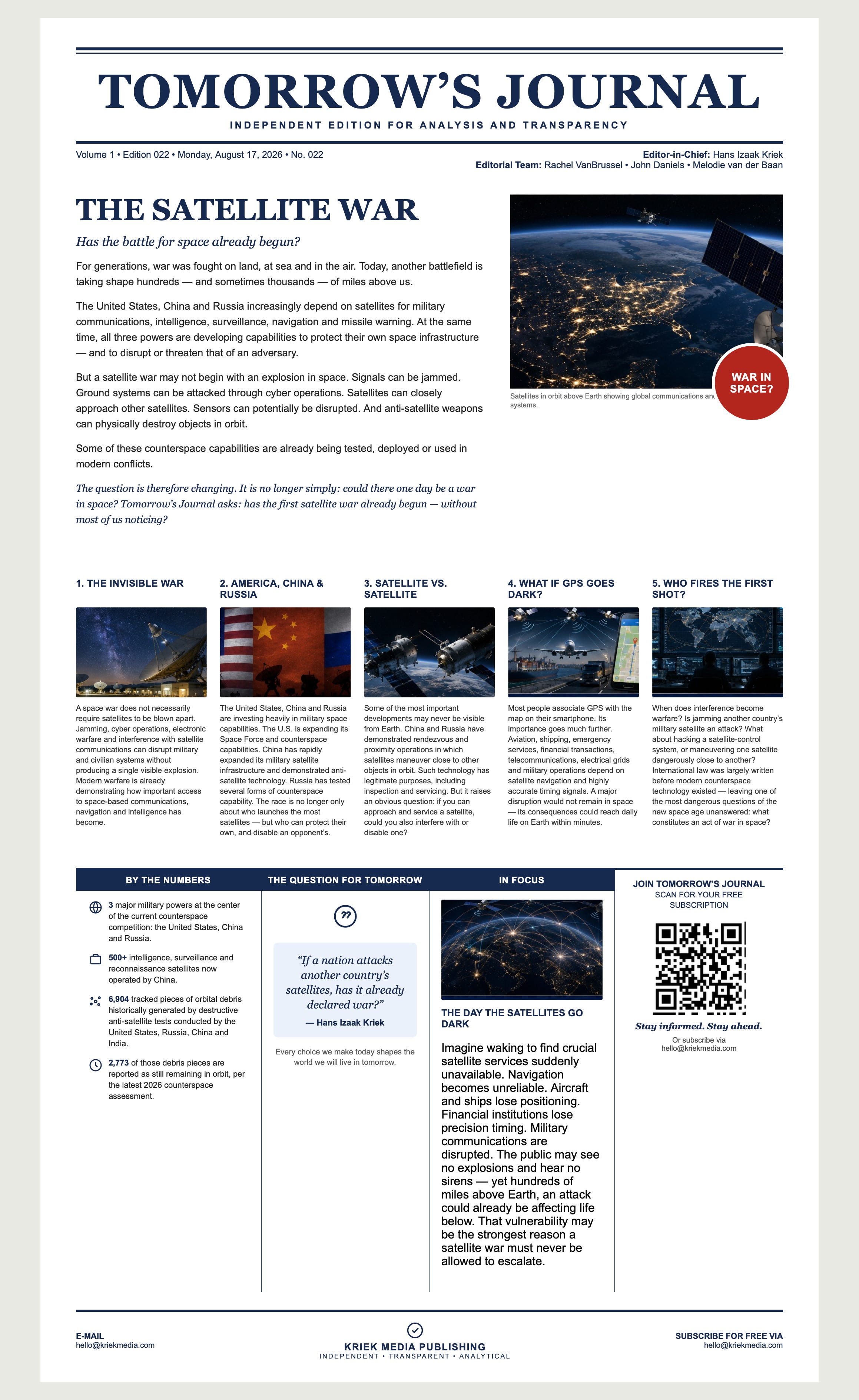
For generations, war was fought on land, at sea and in the air. Today, another battlefield is taking shape hundreds, and sometimes thousands, of miles above us.
The United States, China and Russia increasingly depend on satellites for military communications, intelligence, surveillance, navigation and missile warning. At the same time, all three powers are developing capabilities to protect their own space infrastructure, and to disrupt or threaten that of an adversary.
But a satellite war may not begin with an explosion in space. Signals can be jammed. Ground systems can be attacked through cyber operations. Satellites can closely approach other satellites. Sensors can potentially be disrupted. And anti-satellite weapons can physically destroy objects in orbit.
Some of these counterspace capabilities are already being tested, deployed or used in modern conflicts.
The question is therefore changing. It is no longer simply: could there one day be a war in space? Tomorrow’s Journal asks: has the first satellite war already begun, without most of us noticing?
The Invisible War
A space war does not necessarily require satellites to be blown apart. Jamming, cyber operations, electronic warfare and interference with satellite communications can disrupt military and civilian systems without producing a single visible explosion. Modern warfare is already demonstrating how important access to space-based communications, navigation and intelligence has become.
America, China & Russia
The United States, China and Russia are investing heavily in military space capabilities. The U.S. is expanding its Space Force and counterspace capabilities. China has rapidly expanded its military satellite infrastructure and demonstrated anti-satellite technology. Russia has tested several forms of counterspace capability. The race is no longer only about who launches the most satellites, but who can protect their own, and disable an opponent’s.
Satellite vs. Satellite
Some of the most important developments may never be visible from Earth. China and Russia have demonstrated rendezvous and proximity operations in which satellites maneuver close to other objects in orbit. Such technology has legitimate purposes, including inspection and servicing. But it raises an obvious question: if you can approach and service a satellite, could you also interfere with or disable one?
What if GPS Goes Dark?
Most people associate GPS with the map on their smartphone. Its importance goes much further. Aviation, shipping, emergency services, financial transactions, telecommunications, electrical grids and military operations depend on satellite navigation and highly accurate timing signals. A major disruption would not remain in space: its consequences could reach daily life on Earth within minutes.
Who Fires the First Shot?
When does interference become warfare? Is jamming another country’s military satellite an attack? What about hacking a satellite-control system, or maneuvering one satellite dangerously close to another? International law was largely written before modern counterspace technology existed, leaving one of the most dangerous questions of the new space age unanswered: what constitutes an act of war in space?
By the Numbers
3 major military powers at the center of the current counterspace competition: the United States, China and Russia.
500+ intelligence, surveillance and reconnaissance satellites now operated by China.
6,904 tracked pieces of orbital debris historically generated by destructive anti-satellite tests conducted by the United States, Russia, China and India.
2,773 of those debris pieces are reported as still remaining in orbit, per the latest 2026 counterspace assessment.
The Question for Tomorrow
“If a nation attacks another country’s satellites, has it already declared war?”
Hans Izaak Kriek
Every choice we make today shapes the world we will live in tomorrow.
The Day the Satellites Go Dark
Imagine waking to find crucial satellite services suddenly unavailable. Navigation becomes unreliable. Aircraft and ships lose positioning. Financial institutions lose precision timing. Military communications are disrupted. The public may see no explosions and hear no sirens. Yet hundreds of miles above Earth, an attack could already be affecting life below. That vulnerability may be the strongest reason a satellite war must never be allowed to escalate.