


The Right to Choose — But Who Decides?
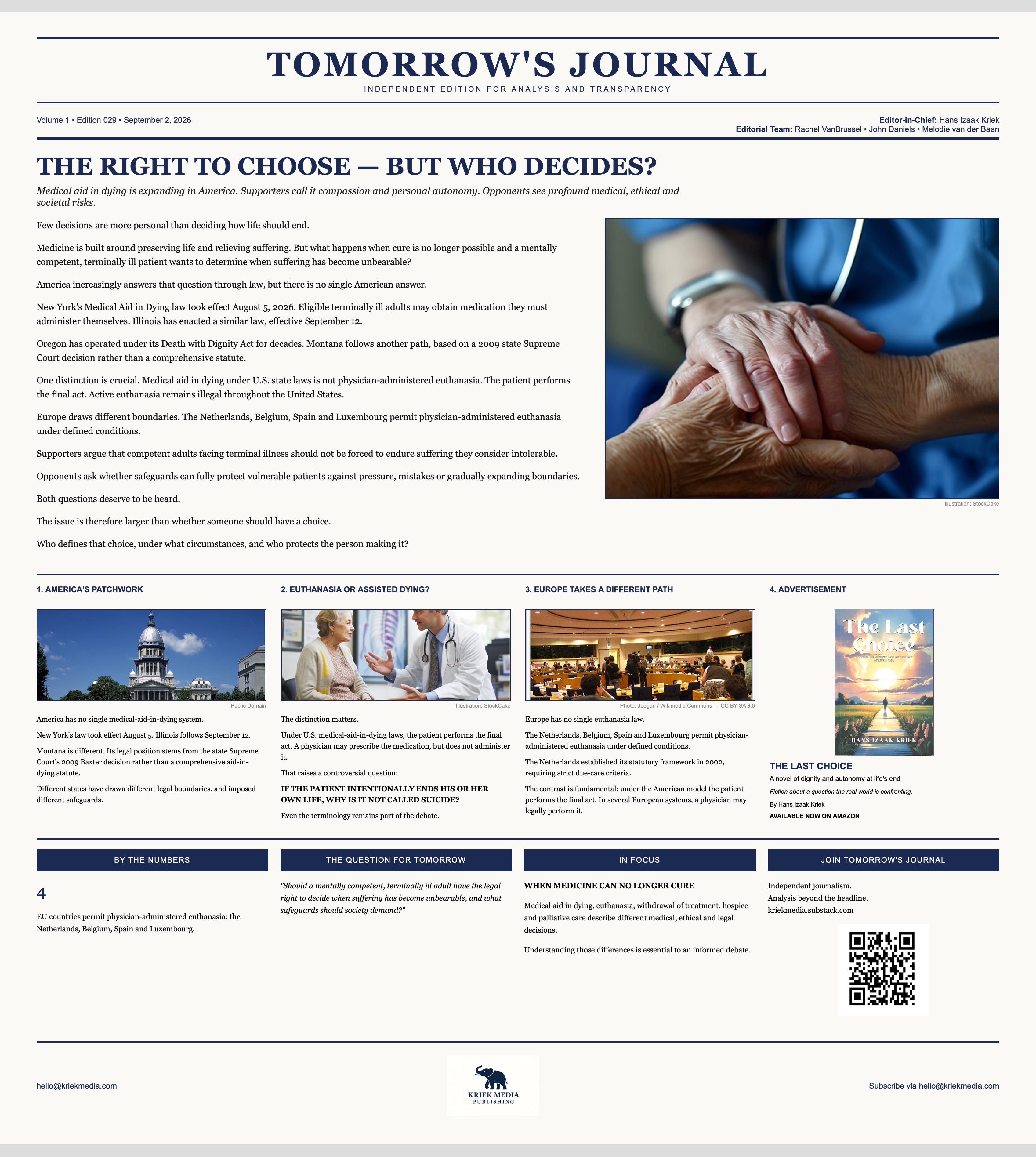
Few decisions are more personal than deciding how life should end.
Medicine is built around preserving life and relieving suffering. But what happens when cure is no longer possible and a mentally competent, terminally ill patient wants to determine when suffering has become unbearable?
America increasingly answers that question through law, but there is no single American answer.
New York’s Medical Aid in Dying law took effect August 5, 2026. Eligible terminally ill adults may obtain medication they must administer themselves. Illinois has enacted a similar law, effective September 12.
Oregon has operated under its Death with Dignity Act for decades. Montana follows another path, based on a 2009 state Supreme Court decision rather than a comprehensive statute.
One distinction is crucial. Medical aid in dying under U.S. state laws is not physician-administered euthanasia. The patient performs the final act. Active euthanasia remains illegal throughout the United States.
Europe draws different boundaries. The Netherlands, Belgium, Spain and Luxembourg permit physician-administered euthanasia under defined conditions.
Supporters argue that competent adults facing terminal illness should not be forced to endure suffering they consider intolerable.
Opponents ask whether safeguards can fully protect vulnerable patients against pressure, mistakes or gradually expanding boundaries.
Both questions deserve to be heard.
The issue is therefore larger than whether someone should have a choice.
Who defines that choice, under what circumstances, and who protects the person making it?
AMERICA’S PATCHWORK
America has no single medical-aid-in-dying system.
New York’s law took effect August 5. Illinois follows September 12.
Montana is different. Its legal position stems from the state Supreme Court’s 2009 Baxter decision rather than a comprehensive aid-in-dying statute.
Different states have drawn different legal boundaries, and imposed different safeguards.
EUTHANASIA OR ASSISTED DYING?
The distinction matters.
Under U.S. medical-aid-in-dying laws, the patient performs the final act. A physician may prescribe the medication, but does not administer it.
That raises a controversial question:
IF THE PATIENT INTENTIONALLY ENDS HIS OR HER OWN LIFE, WHY IS IT NOT CALLED SUICIDE?
Even the terminology remains part of the debate.
EUROPE TAKES A DIFFERENT PATH
Europe has no single euthanasia law.
The Netherlands, Belgium, Spain and Luxembourg permit physician-administered euthanasia under defined conditions.
The Netherlands established its statutory framework in 2002, requiring strict due-care criteria.
The contrast is fundamental: under the American model the patient performs the final act. In several European systems, a physician may legally perform it.
ADVERTISEMENT
THE LAST CHOICE
A novel of dignity and autonomy at life’s end
Fiction about a question the real world is confronting.
By Hans Izaak Kriek
AVAILABLE NOW ON AMAZON
BY THE NUMBERS
4 — EU countries permit physician-administered euthanasia: the Netherlands, Belgium, Spain and Luxembourg.
THE QUESTION FOR TOMORROW
IN FOCUS: WHEN MEDICINE CAN NO LONGER CURE
Medical aid in dying, euthanasia, withdrawal of treatment, hospice and palliative care describe different medical, ethical and legal decisions.
Understanding those differences is essential to an informed debate.
JOIN TOMORROW’S JOURNAL
Independent journalism. Analysis beyond the headline.
kriekmedia.substack.com