

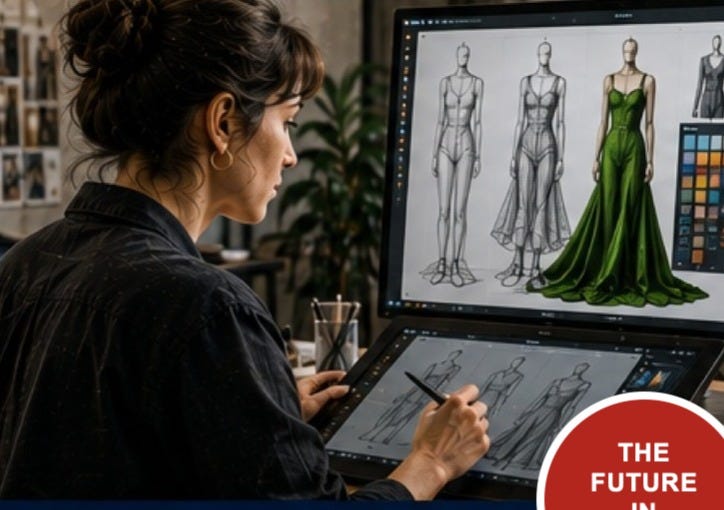
The Future of Fashion
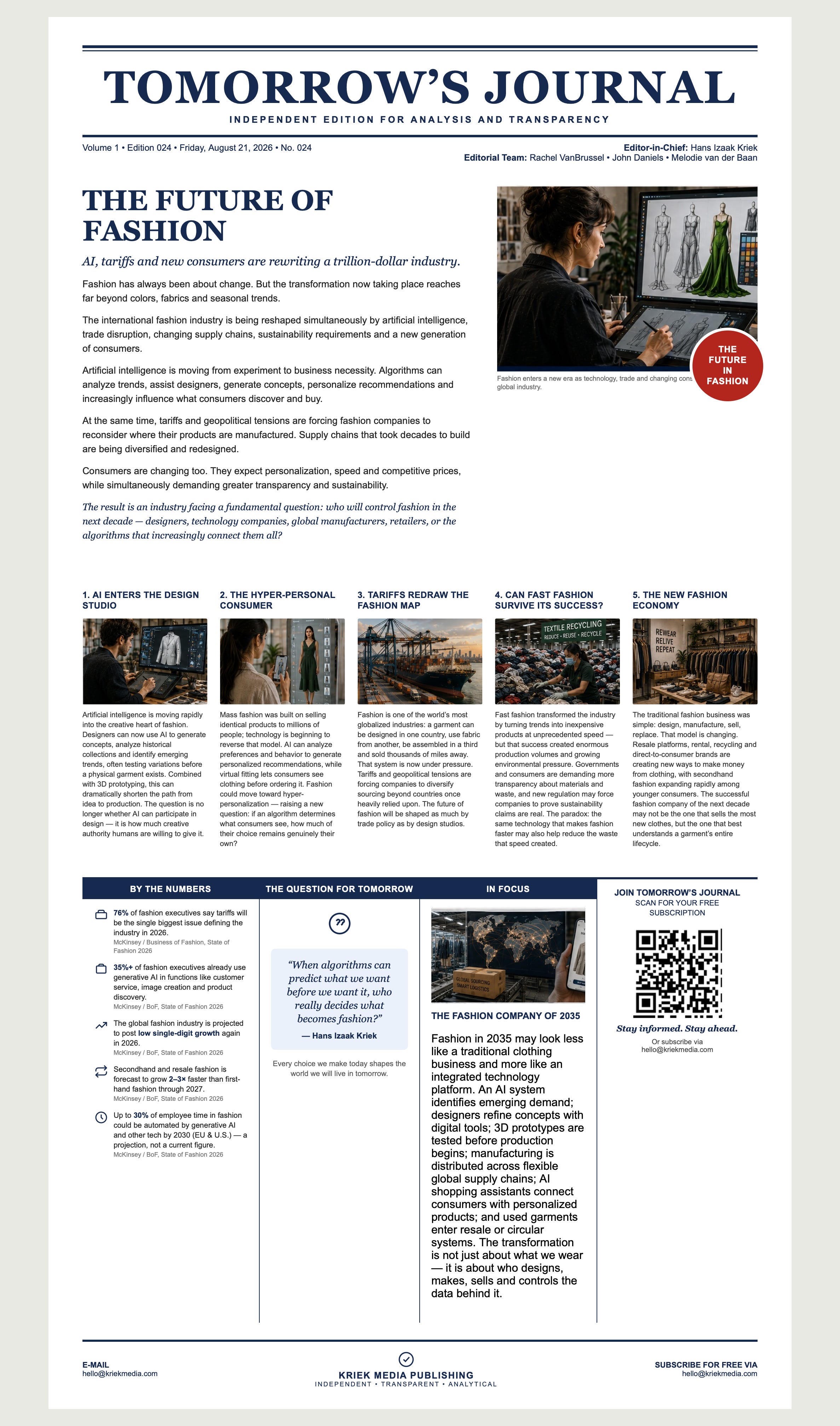
Fashion has always been about change. But the transformation now taking place reaches far beyond colors, fabrics and seasonal trends.
The international fashion industry is being reshaped simultaneously by artificial intelligence, trade disruption, changing supply chains, sustainability requirements and a new generation of consumers.
Artificial intelligence is moving from experiment to business necessity. Algorithms can analyze trends, assist designers, generate concepts, personalize recommendations and increasingly influence what consumers discover and buy.
At the same time, tariffs and geopolitical tensions are forcing fashion companies to reconsider where their products are manufactured. Supply chains that took decades to build are being diversified and redesigned.
Consumers are changing too. They expect personalization, speed and competitive prices, while simultaneously demanding greater transparency and sustainability.
The result is an industry facing a fundamental question: who will control fashion in the next decade: designers, technology companies, global manufacturers, retailers, or the algorithms that increasingly connect them all?
AI Enters the Design Studio
Artificial intelligence is moving rapidly into the creative heart of fashion. Designers can now use AI to generate concepts, analyze historical collections and identify emerging trends, often testing variations before a physical garment exists. Combined with 3D prototyping, this can dramatically shorten the path from idea to production. The question is no longer whether AI can participate in design: it is how much creative authority humans are willing to give it.
The Hyper-Personal Consumer
Mass fashion was built on selling identical products to millions of people; technology is beginning to reverse that model. AI can analyze preferences and behavior to generate personalized recommendations, while virtual fitting lets consumers see clothing before ordering it. Fashion could move toward hyper-personalization, raising a new question: if an algorithm determines what consumers see, how much of their choice remains genuinely their own?
Tariffs Redraw the Fashion Map
Fashion is one of the world’s most globalized industries: a garment can be designed in one country, use fabric from another, be assembled in a third and sold thousands of miles away. That system is now under pressure. Tariffs and geopolitical tensions are forcing companies to diversify sourcing beyond countries once heavily relied upon. The future of fashion will be shaped as much by trade policy as by design studios.
Can Fast Fashion Survive Its Success?
Fast fashion transformed the industry by turning trends into inexpensive products at unprecedented speed, but that success created enormous production volumes and growing environmental pressure. Governments and consumers are demanding more transparency about materials and waste, and new regulation may force companies to prove sustainability claims are real. The paradox: the same technology that makes fashion faster may also help reduce the waste that speed created.
The New Fashion Economy
The traditional fashion business was simple: design, manufacture, sell, replace. That model is changing. Resale platforms, rental, recycling and direct-to-consumer brands are creating new ways to make money from clothing, with secondhand fashion expanding rapidly among younger consumers. The successful fashion company of the next decade may not be the one that sells the most new clothes, but the one that best understands a garment’s entire lifecycle.
By the Numbers
76% of fashion executives say tariffs will be the single biggest issue defining the industry in 2026 (McKinsey / Business of Fashion, State of Fashion 2026).
35%+ of fashion executives already use generative AI in functions like customer service, image creation and product discovery (McKinsey / BoF, State of Fashion 2026).
The global fashion industry is projected to post low single-digit growth again in 2026 (McKinsey / BoF, State of Fashion 2026).
Secondhand and resale fashion is forecast to grow 2 to 3 times faster than first-hand fashion through 2027 (McKinsey / BoF, State of Fashion 2026).
Up to 30% of employee time in fashion could be automated by generative AI and other tech by 2030 (EU and U.S.), a projection, not a current figure (McKinsey / BoF, State of Fashion 2026).
The Question for Tomorrow
“When algorithms can predict what we want before we want it, who really decides what becomes fashion?”
Hans Izaak Kriek
Every choice we make today shapes the world we will live in tomorrow.
The Fashion Company of 2035
Fashion in 2035 may look less like a traditional clothing business and more like an integrated technology platform. An AI system identifies emerging demand; designers refine concepts with digital tools; 3D prototypes are tested before production begins; manufacturing is distributed across flexible global supply chains; AI shopping assistants connect consumers with personalized products; and used garments enter resale or circular systems. The transformation is not just about what we wear: it is about who designs, makes, sells and controls the data behind it.