

Politics on Stage
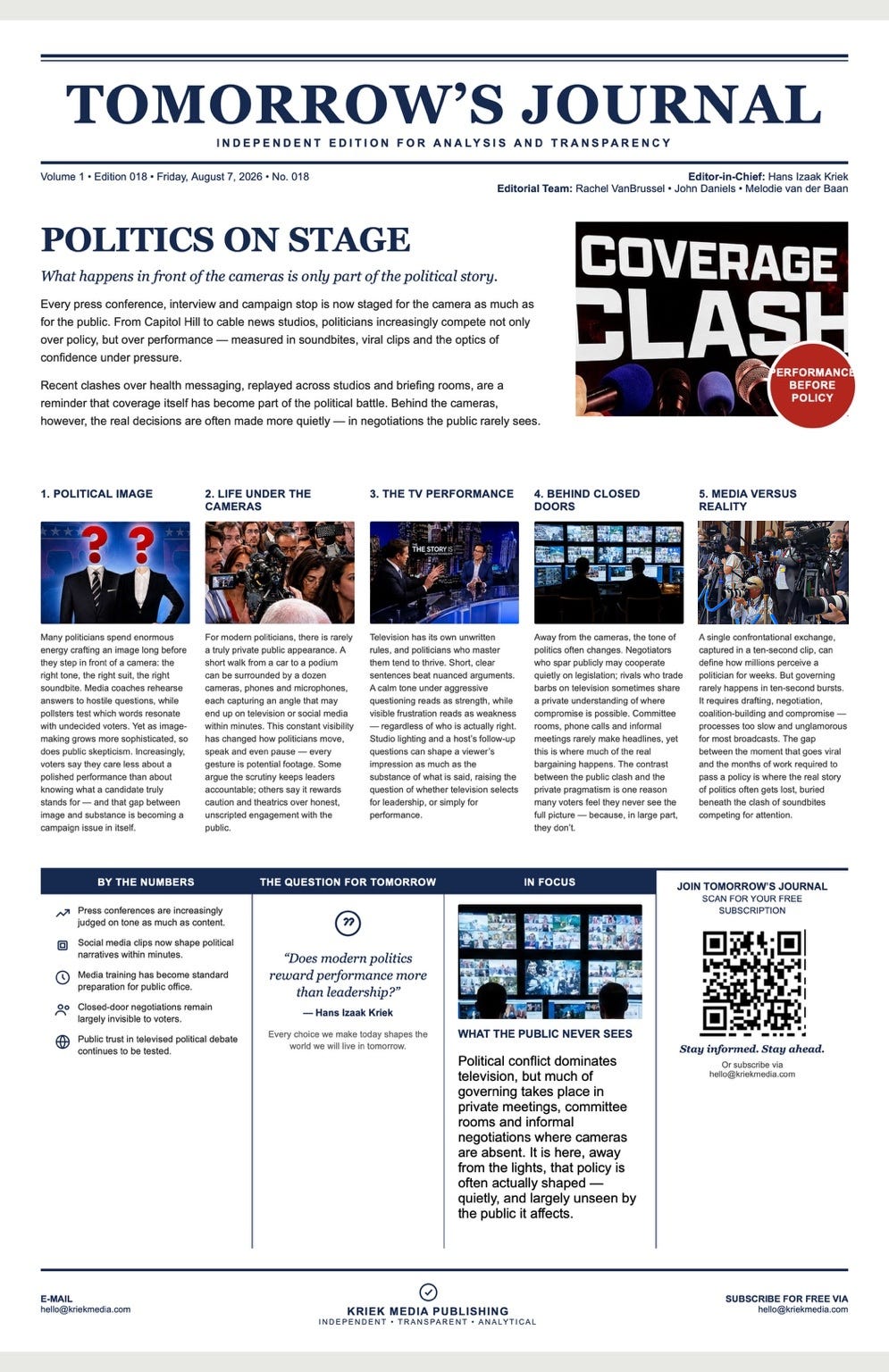
Every press conference, interview and campaign stop is now staged for the camera as much as for the public. From Capitol Hill to cable news studios, politicians increasingly compete not only over policy, but over performance: measured in soundbites, viral clips and the optics of confidence under pressure.
Recent clashes over health messaging, replayed across studios and briefing rooms, are a reminder that coverage itself has become part of the political battle. Behind the cameras, however, the real decisions are often made more quietly, in negotiations the public rarely sees.
Political Image
Many politicians spend enormous energy crafting an image long before they step in front of a camera: the right tone, the right suit, the right soundbite. Media coaches rehearse answers to hostile questions, while pollsters test which words resonate with undecided voters. Yet as image-making grows more sophisticated, so does public skepticism. Increasingly, voters say they care less about a polished performance than about knowing what a candidate truly stands for, and that gap between image and substance is becoming a campaign issue in itself.
Life Under the Cameras
For modern politicians, there is rarely a truly private public appearance. A short walk from a car to a podium can be surrounded by a dozen cameras, phones and microphones, each capturing an angle that may end up on television or social media within minutes. This constant visibility has changed how politicians move, speak and even pause: every gesture is potential footage. Some argue the scrutiny keeps leaders accountable; others say it rewards caution and theatrics over honest, unscripted engagement with the public.
The TV Performance
Television has its own unwritten rules, and politicians who master them tend to thrive. Short, clear sentences beat nuanced arguments. A calm tone under aggressive questioning reads as strength, while visible frustration reads as weakness, regardless of who is actually right. Studio lighting and a host’s follow-up questions can shape a viewer’s impression as much as the substance of what is said, raising the question of whether television selects for leadership, or simply for performance.
Behind Closed Doors
Away from the cameras, the tone of politics often changes. Negotiators who spar publicly may cooperate quietly on legislation; rivals who trade barbs on television sometimes share a private understanding of where compromise is possible. Committee rooms, phone calls and informal meetings rarely make headlines, yet this is where much of the real bargaining happens. The contrast between the public clash and the private pragmatism is one reason many voters feel they never see the full picture, because, in large part, they don’t.
Media Versus Reality
A single confrontational exchange, captured in a ten-second clip, can define how millions perceive a politician for weeks. But governing rarely happens in ten-second bursts. It requires drafting, negotiation, coalition-building and compromise: processes too slow and unglamorous for most broadcasts. The gap between the moment that goes viral and the months of work required to pass a policy is where the real story of politics often gets lost, buried beneath the clash of soundbites competing for attention.
By the Numbers
Press conferences are increasingly judged on tone as much as content.
Social media clips now shape political narratives within minutes.
Media training has become standard preparation for public office.
Closed-door negotiations remain largely invisible to voters.
Public trust in televised political debate continues to be tested.
The Question for Tomorrow
“Does modern politics reward performance more than leadership?”
Hans Izaak Kriek
Every choice we make today shapes the world we will live in tomorrow.
What the Public Never Sees
Political conflict dominates television, but much of governing takes place in private meetings, committee rooms and informal negotiations where cameras are absent. It is here, away from the lights, that policy is often actually shaped: quietly, and largely unseen by the public it affects.