

Faith in a Changing World
Religion is not disappearing. It is changing geography, demographics and political influence.
Across much of Europe, traditional Christian institutions are losing members and influence. In other parts of the world, Christianity continues to expand. Islam is growing in both absolute numbers and as a share of the population in a number of countries, driven partly by younger demographics and migration.
At the same time, Jewish communities in the United States and Europe are confronting renewed concerns about antisemitism and security.
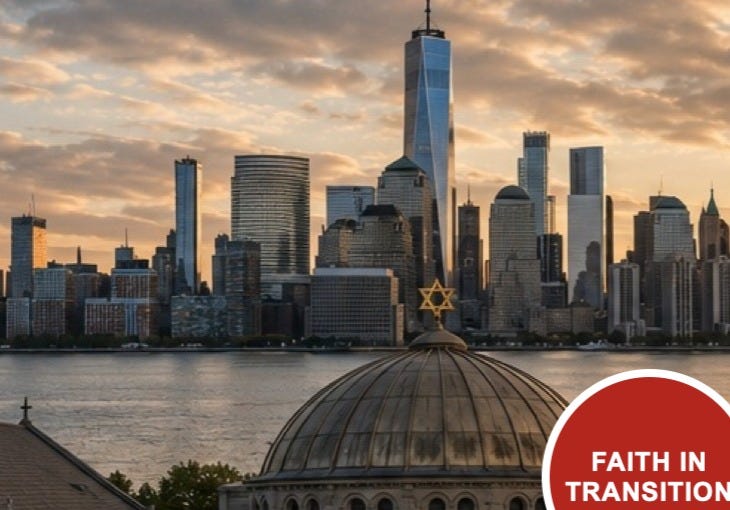
Nowhere are these changes more visible than in New York. The city contains one of the world’s largest Jewish communities outside Israel while also being home to a large and politically increasingly visible Muslim population. The election of Zohran Mamdani as New York City’s first Muslim mayor has added a new dimension to debates about religion, identity, Israel, Gaza and political power.
The central question is therefore no longer simply whether religion will survive in modern society. It is whether increasingly diverse religious communities can continue to share the same cities and democratic institutions without religious identity becoming a source of permanent political conflict.
Christianity: Decline or Transformation?
Traditional Christian institutions have lost influence across much of Europe and parts of North America. Church attendance has declined and younger generations increasingly describe themselves as unaffiliated. But this does not mean Christianity is disappearing globally: it remains substantial and is growing strongly in parts of Africa and the Global South. The geography of Christianity may be changing more dramatically than Christianity itself.
Islam: The Demographic Shift
Islam is one of the world’s major religions, and demographic trends are changing its global weight. Population growth, younger age structures and migration are expanding Muslim communities in many countries. This has also fueled political debate about immigration and integration. The relevant journalistic question is not a claim of demographic transformation, but where legitimate demographic analysis ends and political rhetoric begins.
New York: Jewish Life Under Pressure
New York is home to the largest Jewish population of any city outside Israel. Yet Jewish New Yorkers face growing concerns about antisemitism, hate crimes and security around synagogues, schools and community institutions. The debate over Israel and Gaza has intensified tensions. New York offers a case study: how can one of the world’s most religiously diverse cities protect Jewish life while preserving religious freedom for all communities?
When Faith Becomes Politics
Religion and politics are becoming harder to separate. New York provides a striking example: the city now has its first Muslim mayor, Zohran Mamdani, while simultaneously containing one of the largest Jewish communities in the world. Debates over Israel, Gaza, antisemitism, Islamophobia and religious identity increasingly overlap. Neither Muslims nor Jews are politically uniform communities: the real question is what happens as faith becomes more closely tied to electoral politics.
The Religious World of 2050
The religious map of the world may look different by mid-century. Christianity will remain one of the largest religions, while Islam’s global share is projected to keep growing. Jewish communities will stay numerically small but culturally significant. Unaffiliated populations will remain important too, particularly in Western societies. The future may not be a choice between religion and secularism, but a world where different communities increasingly live side by side.
By the Numbers
2.3 billion Christians worldwide, about 28.8% of the global population (Pew Research Center, 2020 data).
2.0 billion Muslims worldwide, about 25.6% of the global population (Pew Research Center, 2020 data).
15.8 million Jews worldwide, including roughly 1.4 million in Greater New York, the largest Jewish community of any city outside Israel (World Jewish Population 2024; UJA-Federation of New York, 2023).
24% of the world’s population is religiously unaffiliated, up from 23% in 2010 (Pew Research Center, 2020 data).
57% of all hate crimes recorded by the NYPD in 2025 were antisemitic: Jewish New Yorkers were targeted more than all other groups combined (NYPD, 2025).
The Question for Tomorrow
”Can increasingly diverse religions share the same society without becoming political opponents?”
Hans Izaak Kriek
Every choice we make today shapes the world we will live in tomorrow.
The Religious Map of 2050
Religion may not disappear in the decades ahead. Instead, its geography and political significance may change. Population growth, migration, secularization and generational change are reshaping where the world’s major faith communities live. The challenge of 2050 may therefore be less about which religion becomes largest, and more about whether increasingly diverse societies can preserve religious freedom, tolerance and democratic coexistence.