

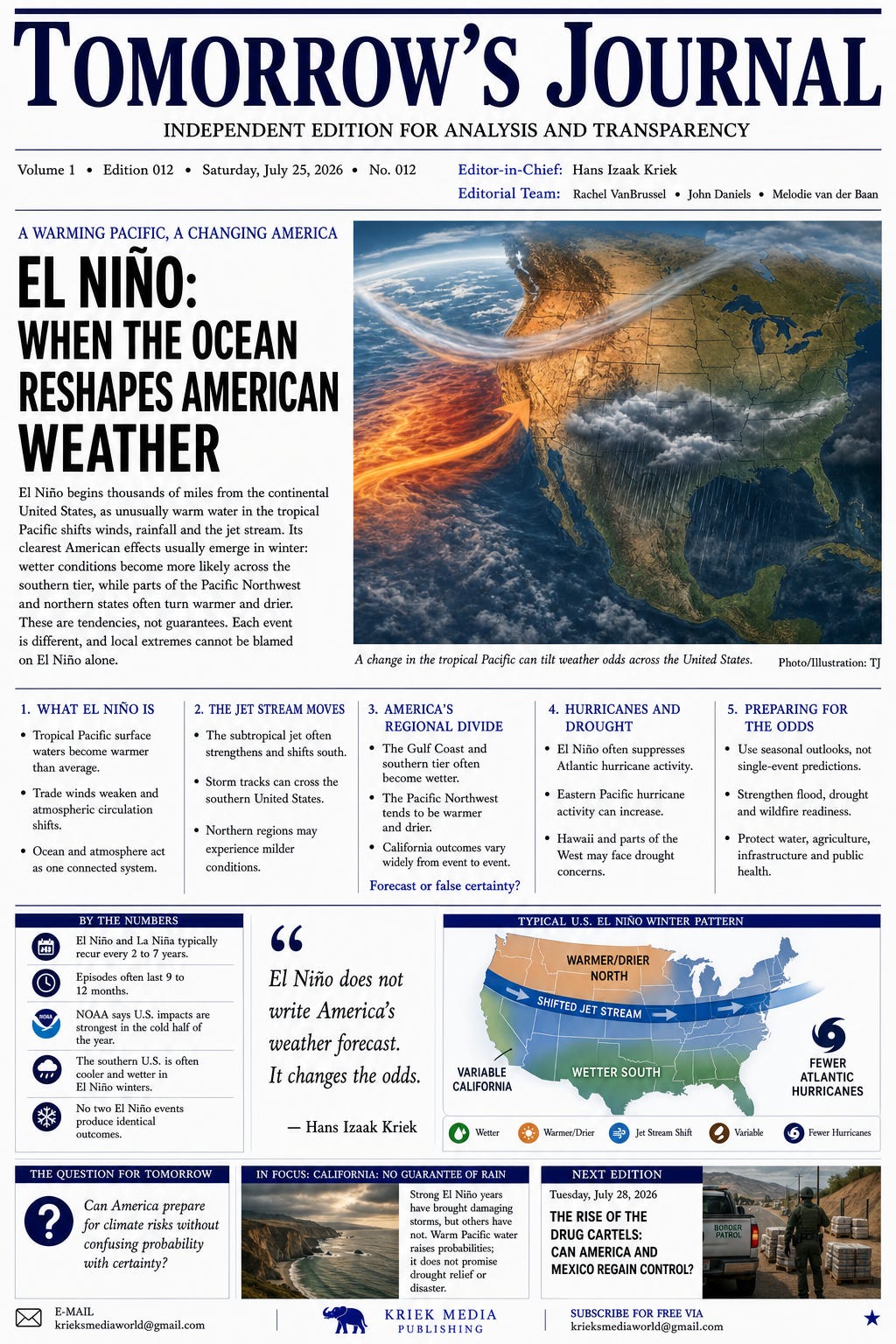
El Niño: When the Ocean Reshapes American Weather, NOAA
What El Niño Is
Tropical Pacific surface waters become warmer than average.
Trade winds weaken and atmospheric circulation shifts.
Ocean and atmosphere act as one connected system.
The Jet Stream Moves
The subtropical jet often strengthens and shifts south.
Storm tracks can cross the southern United States.
Northern regions may experience milder conditions.
America’s Regional Divide
The Gulf Coast and southern tier often become wetter.
The Pacific Northwest tends to be warmer and drier.
California outcomes vary widely from event to event. Forecast or false certainty?
Hurricanes and Drought
El Niño often suppresses Atlantic hurricane activity.
Eastern Pacific hurricane activity can increase.
Hawaii and parts of the West may face drought concerns.
Preparing for the Odds
Use seasonal outlooks, not single-event predictions.
Strengthen flood, drought and wildfire readiness.
Protect water, agriculture, infrastructure and public health.
By the Numbers
El Niño and La Niña typically recur every 2 to 7 years.
Episodes often last 9 to 12 months.
NOAA says U.S. impacts are strongest in the cold half of the year.
The southern U.S. is often cooler and wetter in El Niño winters.
No two El Niño events produce identical outcomes.
El Niño does not write America’s weather forecast. It changes the odds.
Hans Izaak Kriek
Typical U.S. El Niño Winter Pattern
The map illustrates typical El Niño winter tendencies across the country: a warmer, drier north, a shifted jet stream, a wetter south, variable conditions in California, and fewer Atlantic hurricanes.
In Focus: California: No Guarantee of Rain
Strong El Niño years have brought damaging storms, but others have not. Warm Pacific water raises probabilities, it does not promise drought relief or disaster.
Question for Tomorrow
Can America prepare for climate risks without confusing probability with certainty?
If you value independent journalism on geopolitics, international affairs and security, subscribe free to receive every edition of Tomorrow’s Journal.