

Can We Move the Data Center Off Earth?
For years, the cloud made computing seem almost invisible. Artificial intelligence is revealing how physical it really is.
Behind every AI query are processors, servers, buildings, transmission lines and power plants. The more computing power AI requires, the more electricity must be generated, and the more heat must be removed.
That pressure is beginning to show across the United States.
Combined requests from proposed data centers for connections to the electricity grid have exceeded 700 gigawatts. That does not mean America’s data centers will actually consume 700 GW. Regulators and utilities warn that some applications may be speculative or duplicated, the so-called problem of “ghost demand.”
But the figure illustrates the scale of the race.
AI companies need computing capacity. Computing requires electricity. And new data centers can sometimes be planned and built faster than the power plants and transmission infrastructure required to supply them.
Now the search for another solution is accelerating.
Florida-based Lonestar Data Holdings has already demonstrated data-storage technology beyond Earth aboard lunar missions. Cowboy Space is pursuing a much larger idea: solar-powered orbital computing using spacecraft carrying hundreds of GPUs.
Then came SpaceX.
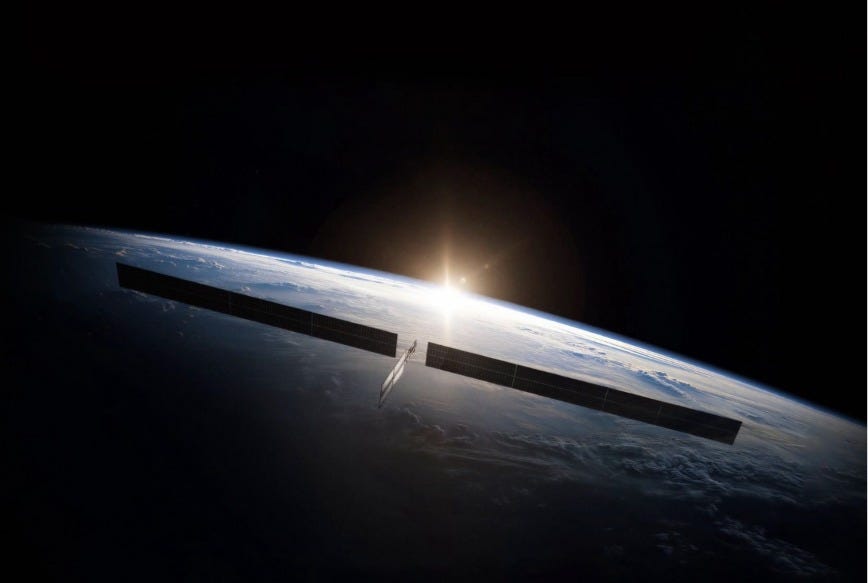
Elon Musk says the first Nvidia-based orbital AI systems are now targeted for launch in the fourth quarter of 2027, with “significant scale” targeted for 2028.
SpaceX has gone much further on paper. In an application to the Federal Communications Commission, the company has sought authority for an orbital data-center system that could eventually involve up to one million satellites.
That number requires perspective.
SpaceX does not have one million AI satellites. The FCC’s acceptance of the application for filing and comment does not authorize their deployment. The figure represents the extraordinary upper scale of what SpaceX is proposing.
The attraction is obvious. Orbital computing could use solar energy without requiring another connection to an overloaded terrestrial grid. It would consume no suburban land and could avoid much of the conventional cooling infrastructure used by data centers on Earth.
But moving the computer does not eliminate the laws of physics.
AI processors still generate heat.
In the vacuum of space there is no surrounding air to remove that heat by convection. Waste heat must instead be transported to radiators and ultimately emitted as thermal radiation.
And if orbital computing ever expands from experiments to thousands, or potentially vastly more, spacecraft, other questions emerge.
What happens to orbital congestion and space debris? What happens when large numbers of satellites eventually re-enter the atmosphere? Could materials released during re-entry affect atmospheric chemistry and the ozone layer?
Scientists are investigating those risks. Their eventual scale remains uncertain.
What began as an answer to AI’s growing appetite for electricity is therefore becoming a much bigger question.
Can we move the data center off Earth, and what happens if we actually succeed?
THE ENERGY PROBLEM
AI may look digital, but its infrastructure is intensely physical. Powerful processors require electricity around the clock, and almost every watt entering the computing equipment ultimately becomes heat that must be managed.
That requires more than server buildings. Power must be generated, transmission lines must deliver it, cooling systems must remove heat and communities must provide land and infrastructure.
Combined U.S. data-center grid-connection requests have exceeded 700 gigawatts. The number is dramatic, but it must be treated carefully.
It does not represent confirmed future electricity consumption.
Utilities and regulators warn that some proposed projects may be speculative, duplicated or submitted to several power providers simultaneously. This “ghost demand” can make future electricity needs appear larger than they eventually are.
Even with that qualification, the direction is clear. AI is increasing pressure on an electricity system that cannot expand instantly.
The competition for artificial intelligence infrastructure is therefore becoming a competition for something much older than software:
electricity, infrastructure and the ability to build fast enough.
FROM THE MOON TO ORBIT
The idea of putting data infrastructure beyond Earth has already moved from theory to experiment.
Florida-based Lonestar Data Holdings sent its Freedom data-storage payload toward the Moon in 2025 aboard an Intuitive Machines mission. It performed storage and processing tests during the journey.
That achievement needs perspective.
A small solid-state storage system is not an industrial AI data center containing thousands of GPUs. But it helped demonstrate that data infrastructure can operate beyond Earth.
Cowboy Space is pursuing the next step.
Led by Robinhood co-founder Baiju Bhatt, the company has raised hundreds of millions of dollars to develop solar-powered computing in orbit. Its plans have included spacecraft carrying hundreds of GPUs at approximately megawatt scale.
An FCC filing has contemplated a future Stampede Data Center System involving as many as 20,000 spacecraft.
Those spacecraft do not exist. Stampede is a proposal, not an operational constellation.
But the progression matters.
First came data storage beyond Earth. Now companies want to move serious computing power there too.
MUSK THINKS BIGGER
SpaceX wants to take orbital computing to an entirely different scale.
The company has worked with Nvidia on AI hardware designed for operation beyond Earth. Elon Musk says the first Nvidia-based systems are targeted for launch in the fourth quarter of 2027, with “significant scale” targeted for 2028.
Then comes the extraordinary number.
SpaceX has asked the Federal Communications Commission to authorize an orbital data-center system involving up to one million satellites.
That is not approved fleet.
SpaceX does not possess one million satellites, and FCC acceptance of the application for filing and comment does not authorize that deployment.
The figure represents the upper scale for which SpaceX has sought regulatory authority.
Even with those qualifications, the application makes an important statement.
Orbital AI is moving from technological experiment toward a serious industrial ambition.
THE COOLING PARADOX
Space offers an apparently remarkable advantage for computing: abundant solar energy without connection to the terrestrial electricity grid.
But generating the electricity is only half the problem.
AI processors still generate heat.
On Earth, data centers can move that heat into moving air or water. Space has no atmosphere surrounding a spacecraft, so there is no comparable convective cooling.
Waste heat must instead be moved to radiators and emitted as thermal radiation. SpaceX’s own technical material acknowledges the need for substantially larger radiators for AI-compute satellites.
Scale therefore matters.
Cooling a small storage payload is fundamentally different from rejecting the heat generated by hundreds or thousands of powerful processors.
Then come additional environmental questions. Larger constellations could increase orbital congestion and debris risks. Researchers are also investigating whether materials released during satellite re-entry, including aluminum oxides, could affect atmospheric chemistry and contribute to ozone depletion.
That is a potential risk, not a proven outcome.
Space may eliminate some terrestrial constraints. It creates new ones of its own.
CONCLUDING ANALYSIS: ESCAPING THE GRID
The idea is seductive.
AI needs electricity. Space offers sunlight. Data centers require land. Orbit contains none. Terrestrial cooling systems require substantial infrastructure. Space offers an entirely different thermal environment.
But every advantage comes with another question.
The electricity may be generated in orbit, but the data may still need to leave orbit. Maintenance that can be performed by technicians on Earth becomes vastly more complicated in space.
And scale changes everything.
A single experimental payload is one thing. Hundreds of high-powered computing satellites are another. Tens of thousands would create an infrastructure system in orbit. One million, if anything approaching that number ever materialized, would represent something unprecedented.
That is why the SpaceX proposal matters even if its maximum scale is never reached.
It forces a question that scarcely existed a few years ago: is physical appetite so large that companies are seriously considering moving part of the computing infrastructure beyond the planet?
Perhaps orbital computing will find specialized applications while terrestrial data centers continue to dominate.
Or perhaps the engineering, economic and environmental obstacles will prove too great.
We do not know.
But the cloud is no longer just a metaphor.
The race has begun to discover whether part of it can actually leave Earth.
BY THE NUMBERS
700+ GW: Combined power represented by U.S. data-center grid-connection requests. Some may represent speculative or duplicate “ghost demand.”
$275 million: Financing announced by Cowboy Space in 2026.
~800 GPUs: Cowboy Space’s stated target for a single pre-proposal orbital computing spacecraft.
Up to 20,000: Spacecraft contemplated for Cowboy Space’s Stampede Data Center System. Proposed, not deployed.
Up to 1,000,000: Satellites contemplated in SpaceX’s FCC orbital-data-center application. Proposed, not deployed.
THE QUESTION FOR TOMORROW
Can AI escape Earth without bringing its problems with it?
Orbital computing could reduce some of the pressure AI places on electricity grids, land and terrestrial cooling systems.
But can it operate economically at enormous scale?
Can thousands of powerful computing satellites be cooled and maintained safely? And what happens to orbit and Earth’s infrastructure if those satellites eventually reach the end of their lives?
AI may be leaving Earth for the infrastructure it needs. But even in space, the laws of physics remain.
IN FOCUS: THE COOLING PARADOX
Space is cold. Vacuum is not a cooling system.
On Earth: Processors, then heat, then air or water, then cooling infrastructure.
In space: Processors, then heat, then radiators, then thermal radiation into space.
Space removes conventional atmospheric convection. It does not remove the heat.
For small systems that challenge can be manageable. For industrial AI computing consuming megawatts of electricity, heat rejection becomes part of the fundamental spacecraft architecture.
Space provides the sunlight. Physics still sends the bill.
JOIN TOMORROW’S JOURNAL
Independent journalism. Analysis beyond the headline.
Or subscribe via hello@kriekmedia.com