

Can the United Nations Still Change the World?
Nearly 130 world leaders have gathered in New York. Donald Trump defended American power. António Guterres called for cooperation and reform.
But some of the week’s most consequential diplomacy is taking place not at the podium, but behind closed doors.
The United Nations can still bring the world together.
But is it still the place where the world decides?
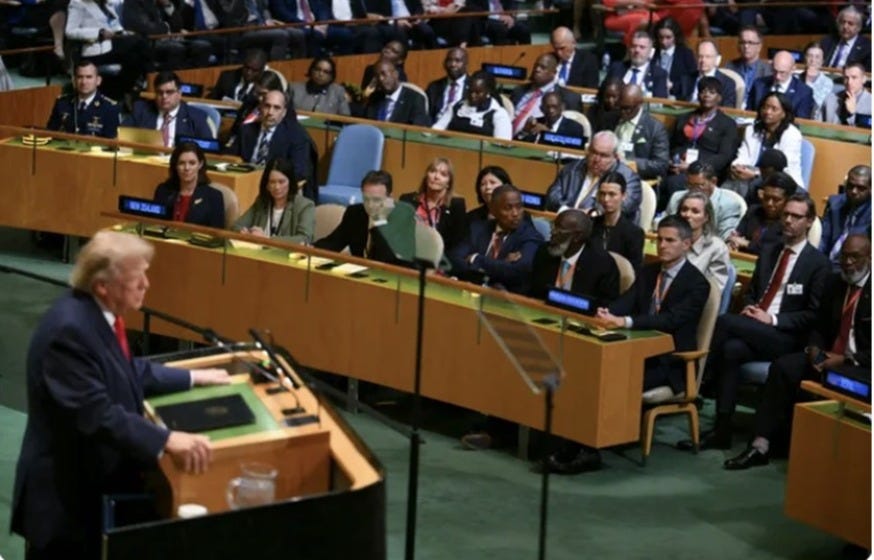
President Donald Trump made that tension unmistakable Tuesday.
In a 37-minute address, Trump defended American military action against Iran and warned Tehran of devastating consequences if confrontation continues. At the same time, he left open the possibility of an eventual agreement.
Trump also addressed Ukraine, American power and artificial intelligence. He described AI as potentially more consequential than the Industrial Revolution and promoted the idea of “super intelligence.”
Then came a very different message.
In his final General Assembly address as Secretary-General, António Guterres called for international cooperation, institutional reform and stronger collective action on war, climate change and artificial intelligence.
Two speeches. Two visions of how power works.
The contrast goes to the heart of an institution created in 1945.
The United Nations gives virtually every country a seat and a voice. But it does not give every country equal power.
The General Assembly can debate, adopt resolutions and mobilize international opinion. On questions of international peace and security, the Security Council has primary responsibility. Its five permanent members (China, France, Russia, the United Kingdom and the United States) possess veto power.
That structure becomes particularly visible when major powers disagree.
Wars continue. Iran remains a major security challenge. Ukraine is unresolved. Artificial intelligence is developing faster than governments have agreed on international rules.
Guterres himself argues that international institutions need reform.
Yet another United Nations was visible away from the podium.
Trump met Ukrainian President Volodymyr Zelensky in New York to discuss efforts to end the war, including a possible arrangement involving attacks on energy infrastructure.
American and Iranian representatives also held contacts in New York after Trump had used the General Assembly podium to issue one of his strongest warnings to Tehran.
No breakthrough was announced.
But the contrast was striking:
Confrontation before the world.
Negotiation behind closed doors.
That does not necessarily make the United Nations irrelevant.
Bringing presidents, prime ministers and diplomats into the same city may itself be one of the organization’s remaining sources of influence.
The United Nations may still be the place where the world meets.
Is it still the place where the world decides?
TRUMP TAKES THE STAGE
Trump’s address presented a view of international affairs centered strongly on national power.
Iran dominated much of the speech. Trump defended American military action, warned Tehran against continued confrontation and simultaneously left open the possibility of negotiations.
He also addressed Ukraine and artificial intelligence. On AI, Trump rejected efforts he believes could unnecessarily restrict development and described the technology as potentially more consequential than the Industrial Revolution.
The significance was larger than the individual policy statements.
Trump was speaking from the world’s most prominent multilateral stage while emphasizing what the United States itself is prepared to do.
That produced one of the central contradictions of this General Assembly:
World leaders come to New York to speak collectively while continuing to rely heavily on national power.
GUTERRES: A UN UNDER PRESSURE
António Guterres delivered his final General Assembly address as Secretary-General with a different emphasis.
He called for international cooperation, institutional reform and stronger collective action on war and climate change.
Artificial intelligence received particular attention. Guterres argued for international AI governance and independent oversight as the technology develops rapidly.
His message also exposed the challenge facing the institution he has led.
The United Nations provides diplomacy, humanitarian assistance, international standards and a forum in which 193 countries can be heard.
But implementation ultimately depends on governments.
When major powers disagree, collective action can stall.
His successor will inherit more than an organization.
The next Secretary-General will inherit a fundamental question:
Can a system created after World War II adapt quickly enough to today’s distribution of power?
FIVE NATIONS CAN SAY NO
The United Nations has 193 member states.
But on international peace and security, five countries occupy a unique position.
China, France, Russia, the United Kingdom and the United States are permanent members of the Security Council and possess veto power.
That arrangement dates from the international order created after World War II.
The General Assembly can provide political legitimacy, expose divisions and build international coalitions.
But it cannot simply override a Security Council veto.
Calls for reform have therefore become a recurring part of UN diplomacy.
The contradiction is difficult to escape.
The United Nations is based on the principle that nations meet within one international organization.
But when the stakes are highest, five governments retain powers the other 188 do not.
THE REAL DIPLOMACY?
Hours after Trump threatened Iran from the General Assembly podium, American and Iranian representatives were talking.
Trump also met Ukrainian President Volodymyr Zelensky in New York. Their discussion included efforts to end the war and the possibility of limiting attacks on energy infrastructure.
No breakthrough was announced in either case.
But the sequence matters.
The General Assembly concentrates presidents, prime ministers and diplomats in one city, creating opportunities for direct conversations that might otherwise take considerably longer to arrange.
That creates a paradox.
The United Nations may have limited power to compel major governments to act.
Yet by bringing their leaders together, it creates the physical and diplomatic environment in which agreements may become possible.
Perhaps the General Assembly Hall is not where every decision is made.
But without the gathering, some of those conversations might never happen.
CONCLUDING ANALYSIS: A STAGE, OR A CENTER OF POWER?
The evidence points in two directions.
The United Nations remains the only global political institution in which virtually every country can speak. It coordinates humanitarian work, establishes international standards, provides diplomatic channels and brings adversaries into the same place.
But presence is not power.
The conflicts confronting this General Assembly demonstrate the limits of collective institutions when governments with military, economic or veto power refuse to agree.
And yet the alternative presents its own problem.
Iran, Ukraine, climate change, global trade and artificial intelligence do not stop at national borders.
A weaker United Nations would not make those problems disappear. It would leave governments with fewer places in which to confront them collectively.
This week’s diplomacy reveals the paradox.
The United Nations may have lost some of its power to decide.
But it still has the power to bring the people who decide into the same place.
BY THE NUMBERS
193: UN member states.
5: Permanent Security Council members with veto power.
Nearly 130: Heads of state and government gathering in New York.
81st: Session of the UN General Assembly.
THE QUESTION FOR TOMORROW
IF THE UNITED NATIONS CANNOT STOP THE WARS, WHO STILL NEEDS THE UNITED NATIONS?
IN FOCUS
INSIDE THE UN
193 member states, General Assembly, Security Council, global rules.
versus
OUTSIDE THE HALL
Bilateral meetings, military alliances, security agreements, direct diplomacy.
JOIN TOMORROW’S JOURNAL
Independent journalism. Analysis beyond the headline.
Or subscribe via hello@kriekmedia.com