

NATO 2026: Can Europe Stand on Its Own?
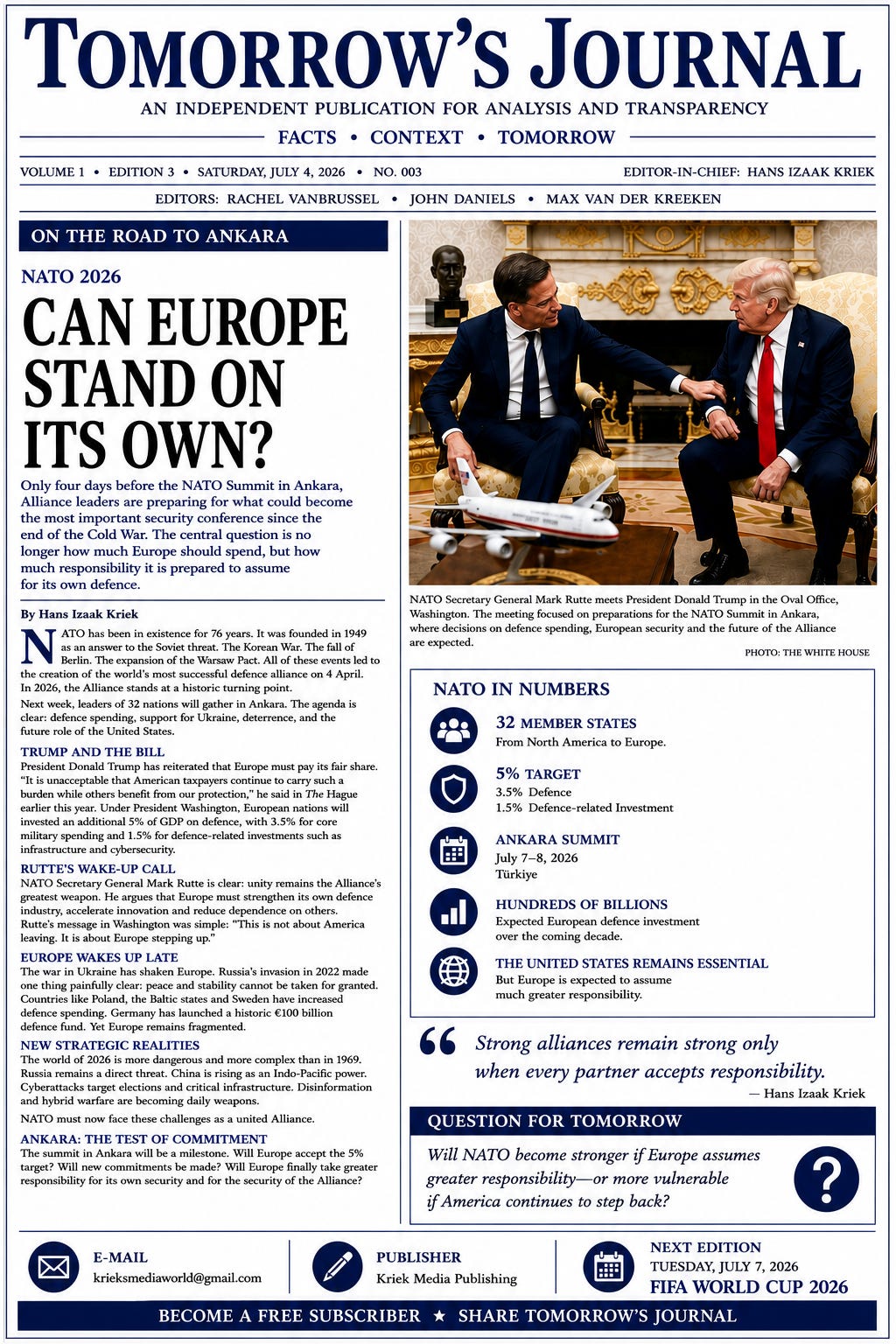
Can Europe Stand on Its Own?
Days before the NATO Summit in Ankara, Europe faces a defining question about defense, responsibility and the future of the Alliance.
Only four days before the NATO Summit in Ankara, Alliance leaders are preparing for what could become the most important security conference since the end of the Cold War. The central question is no longer how much Europe should spend, but how much responsibility it is prepared to assume for its own defense.
By Hans Izaak Kriek
NATO has been in existence for 76 years. It was founded in 1949 as an answer to the Soviet threat. The Korean War. The fall of Berlin. The expansion of the Warsaw Pact. All of these events led to the creation of the world’s most successful defense alliance on April 4. In 2026, the Alliance stands at a historic turning point.
Next week, leaders of 32 nations will gather in Ankara. The agenda is clear: defense spending, support for Ukraine, deterrence, and the future role of the United States.
Trump and the Bill
President Donald Trump has reiterated that Europe must pay its fair share.
“It is unacceptable that American taxpayers continue to carry such a burden while others benefit from our protection,” he said in The Hague earlier this year. Under President Washington, European nations will invest an additional 5% of GDP on defense, with 3.5% for core military spending and 1.5% for defense-related investments such as infrastructure and cybersecurity.
Rutte’s Wake-Up Call
NATO Secretary General Mark Rutte is clear: unity remains the Alliance’s greatest weapon. He argues that Europe must strengthen its own defense industry, accelerate innovation and reduce dependence on others.
Rutte’s message in Washington was simple: “This is not about America leaving. It is about Europe stepping up.”
Europe Wakes Up Late
The war in Ukraine has shaken Europe. Russia’s invasion in 2022 made one thing painfully clear: peace and stability cannot be taken for granted.
Countries like Poland, the Baltic states and Sweden have increased defense spending. Germany has launched a historic €100 billion defense fund. Yet Europe remains fragmented.
New Strategic Realities
The world of 2026 is more dangerous and more complex than in 1969.
Russia remains a direct threat.
China is rising as an Indo-Pacific power.
Cyberattacks target elections and critical infrastructure.
Disinformation and hybrid warfare are becoming daily weapons.
NATO must now face these challenges as a united Alliance.
Ankara: The Test of Commitment
The summit in Ankara will be a milestone.
Will Europe accept the 5% target?
Will new commitments be made?
Will Europe finally take greater responsibility for its own security and for the security of the Alliance?
“Strong alliances remain strong only when every partner accepts responsibility.”
Hans Izaak Kriek
Editor-in-Chief
Question for Tomorrow
Will NATO become stronger if Europe assumes greater responsibility, or more vulnerable if America continues to step back?
As NATO enters a new chapter, the decisions made in Ankara may shape European security for years to come. Leadership, commitment and shared responsibility will determine the strength of the Alliance.
If you value independent journalism on geopolitics, international affairs and security, subscribe free to receive every edition of Tomorrow’s Journal.