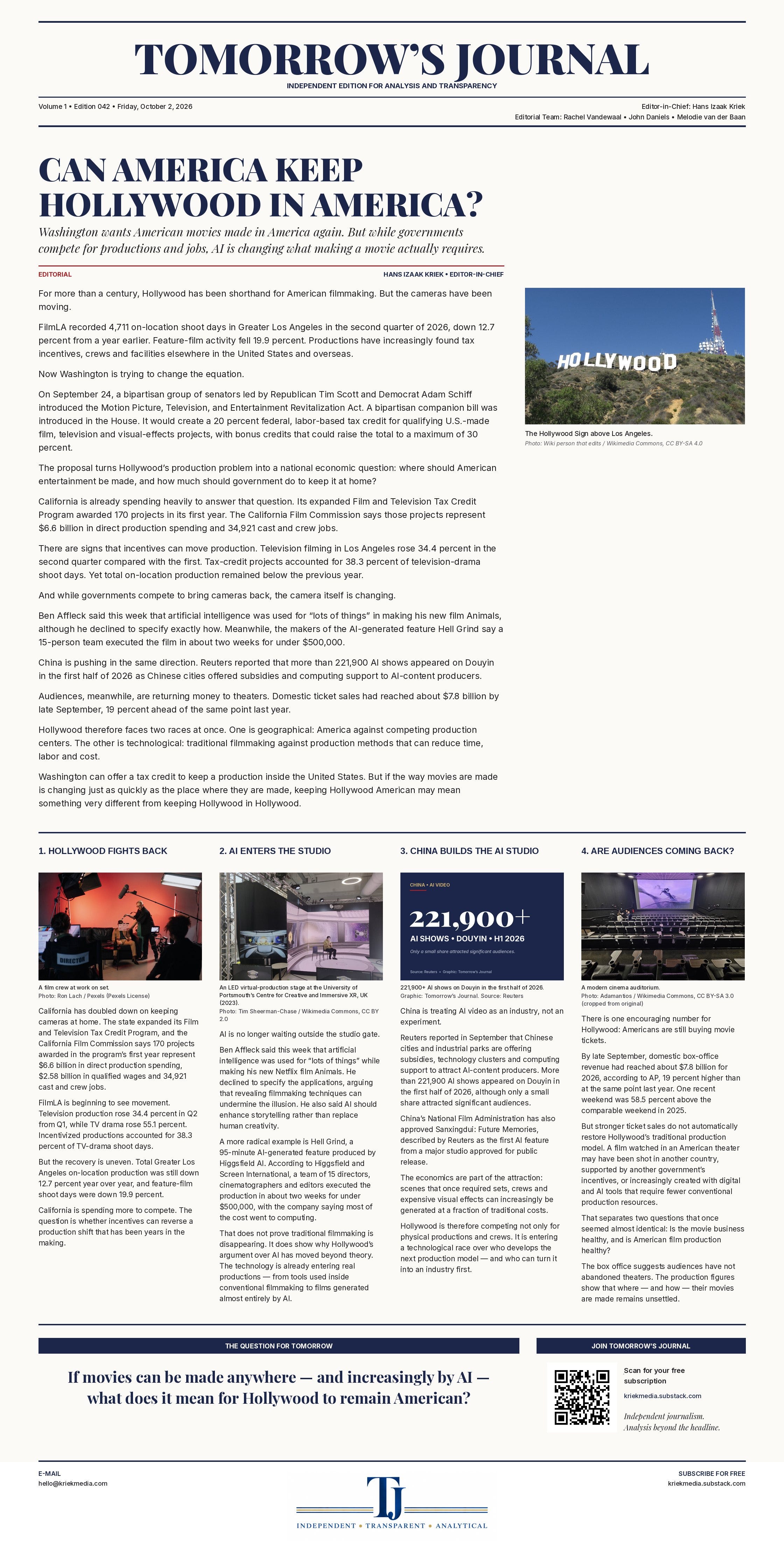

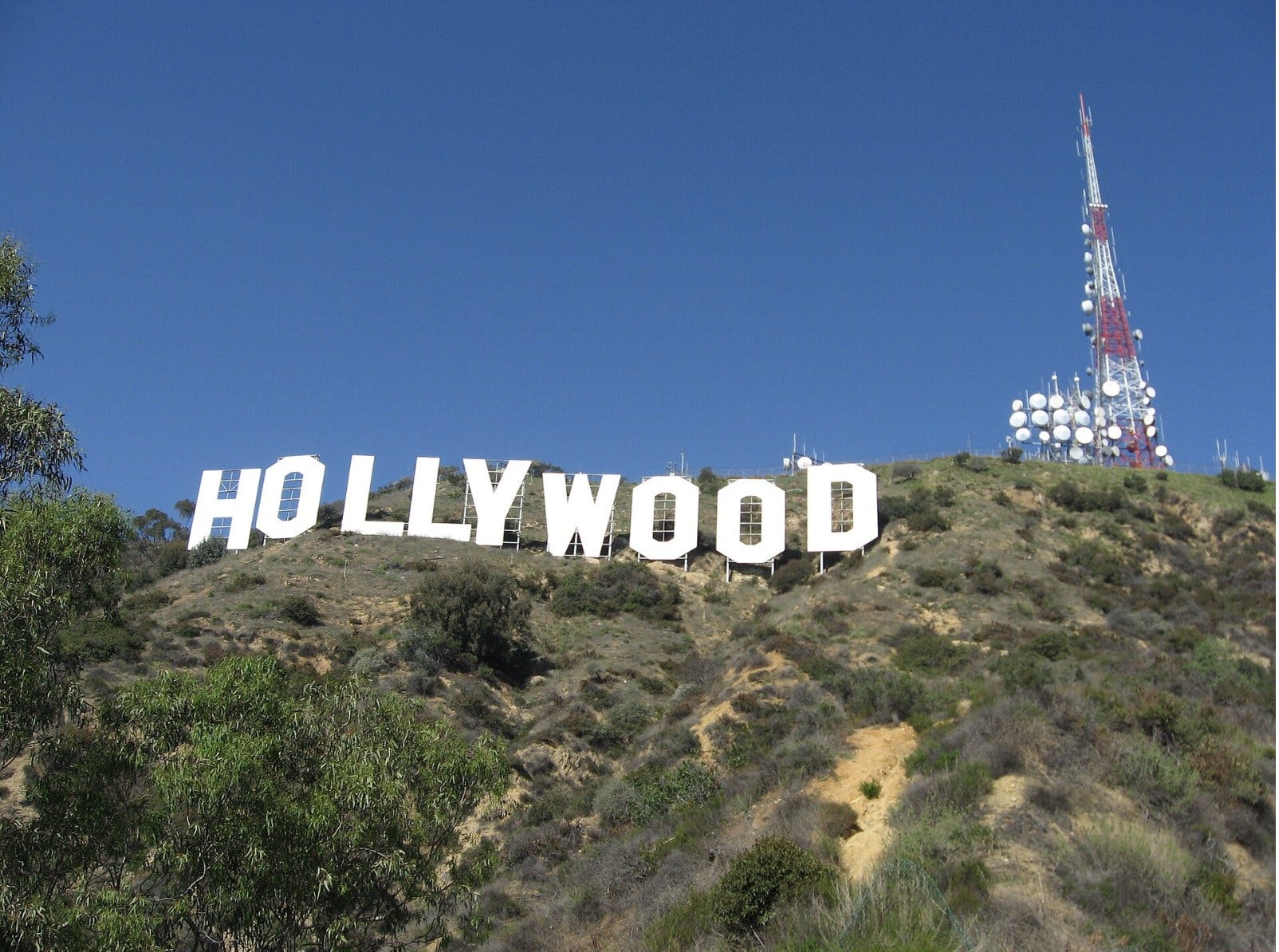
For more than a century, Hollywood has been shorthand for American filmmaking. But the cameras have been moving.
FilmLA recorded 4,711 on-location shoot days in Greater Los Angeles in the second quarter of 2026, down 12.7 percent from a year earlier. Feature-film activity fell 19.9 percent. Productions have increasingly found tax incentives, crews and facilities elsewhere in the United States and overseas.
Now Washington is trying to change the equation.
On September 24, a bipartisan group of senators led by Republican Tim Scott and Democrat Adam Schiff introduced the Motion Picture, Television, and Entertainment Revitalization Act. A bipartisan companion bill was introduced in the House. It would create a 20 percent federal, labor-based tax credit for qualifying U.S.-made film, television and visual-effects projects, with bonus credits that could raise the total to a maximum of 30 percent.
The proposal turns Hollywood’s production problem into a national economic question: where should American entertainment be made, and how much should government do to keep it at home?
California is already spending heavily to answer that question. Its expanded Film and Television Tax Credit Program awarded 170 projects in its first year. The California Film Commission says those projects represent $6.6 billion in direct production spending and 34,921 cast and crew jobs.
There are signs that incentives can move production. Television filming in Los Angeles rose 34.4 percent in the second quarter compared with the first. Tax-credit projects accounted for 38.3 percent of television-drama shoot days. Yet total on-location production remained below the previous year.
And while governments compete to bring cameras back, the camera itself is changing.
Ben Affleck said this week that artificial intelligence was used for “lots of things” in making his new film Animals, although he declined to specify exactly how. Meanwhile, the makers of the AI-generated feature Hell Grind say a 15-person team executed the film in about two weeks for under $500,000.
China is pushing in the same direction. Reuters reported that more than 221,900 AI shows appeared on Douyin in the first half of 2026 as Chinese cities offered subsidies and computing support to AI-content producers.
Audiences, meanwhile, are returning money to theaters. Domestic ticket sales had reached about $7.8 billion by late September, 19 percent ahead of the same point last year.
Hollywood therefore faces two races at once. One is geographical: America against competing production centers. The other is technological: traditional filmmaking against production methods that can reduce time, labor and cost.
Washington can offer a tax credit to keep a production inside the United States. But if the way movies are made is changing just as quickly as the place where they are made, keeping Hollywood American may mean something very different from keeping Hollywood in Hollywood.
1. HOLLYWOOD FIGHTS BACK
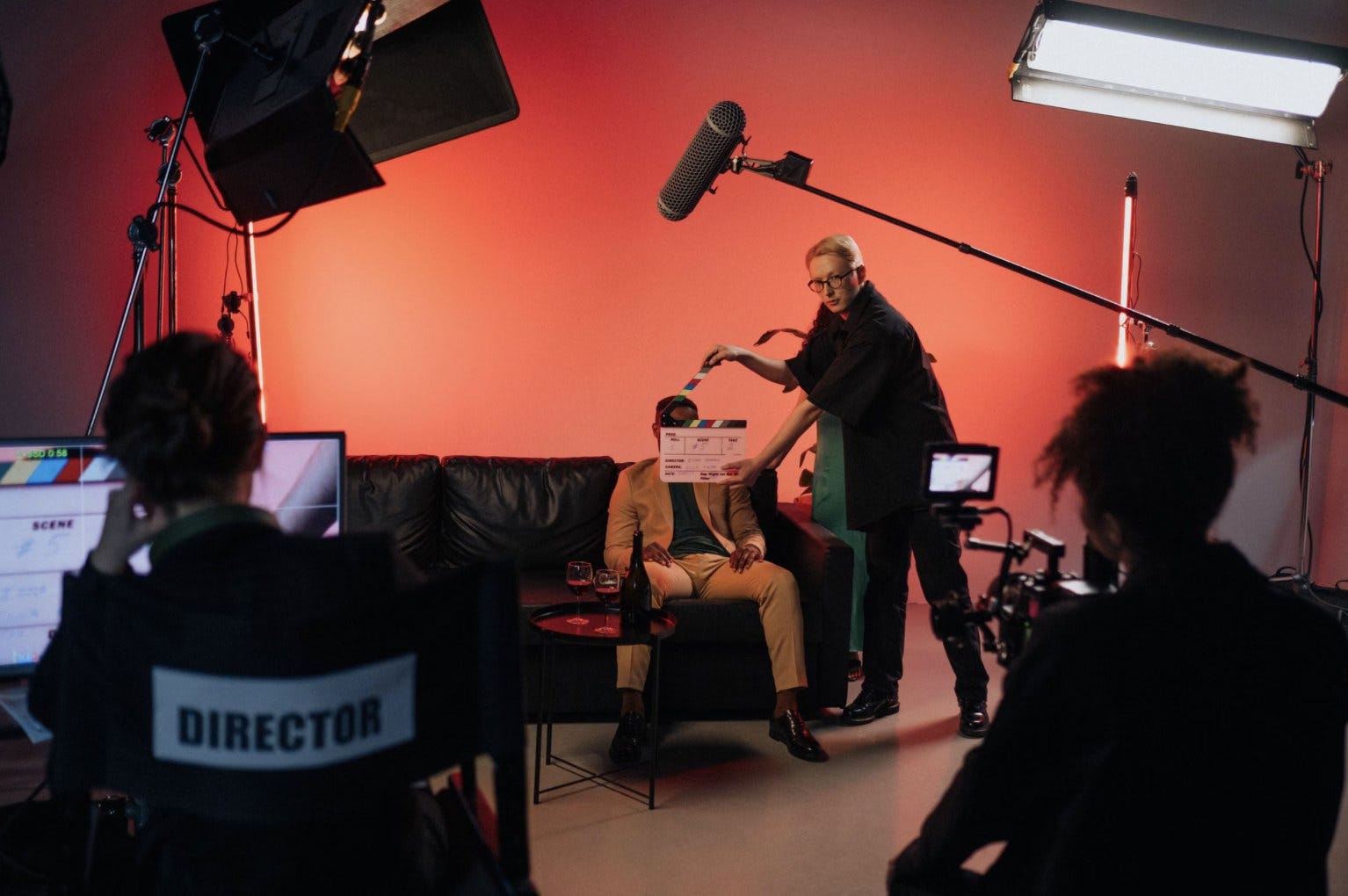
California has doubled down on keeping cameras at home. The state expanded its Film and Television Tax Credit Program, and the California Film Commission says 170 projects awarded in the program’s first year represent $6.6 billion in direct production spending, $2.58 billion in qualified wages and 34,921 cast and crew jobs.
FilmLA is beginning to see movement. Television production rose 34.4 percent in Q2 from Q1, while TV drama rose 55.1 percent. Incentivized productions accounted for 38.3 percent of TV-drama shoot days.
But the recovery is uneven. Total Greater Los Angeles on-location production was still down 12.7 percent year over year, and feature-film shoot days were down 19.9 percent.
California is spending more to compete. The question is whether incentives can reverse a production shift that has been years in the making.
2. AI ENTERS THE STUDIO
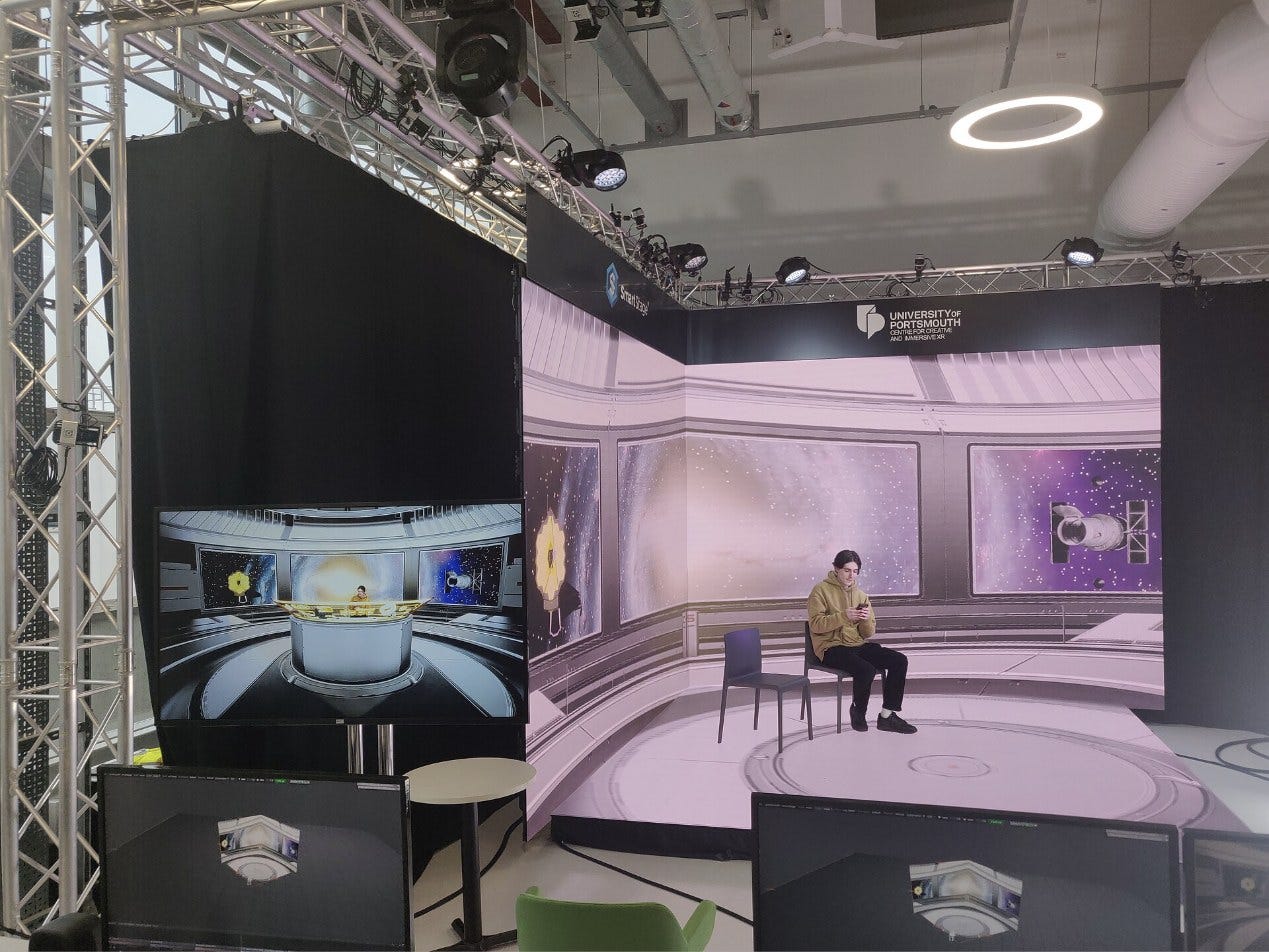

AI is no longer waiting outside the studio gate.
Ben Affleck said this week that artificial intelligence was used for “lots of things” while making his new Netflix film Animals. He declined to specify the applications, arguing that revealing filmmaking techniques can undermine the illusion. He also said AI should enhance storytelling rather than replace human creativity.
A more radical example is Hell Grind, a 95-minute AI-generated feature produced by Higgsfield AI. According to Higgsfield and Screen International, a team of 15 directors, cinematographers and editors executed the production in about two weeks for under $500,000, with the company saying most of the cost went to computing.
That does not prove traditional filmmaking is disappearing. It does show why Hollywood’s argument over AI has moved beyond theory. The technology is already entering real productions — from tools used inside conventional filmmaking to films generated almost entirely by AI.
3. CHINA BUILDS THE AI STUDIO
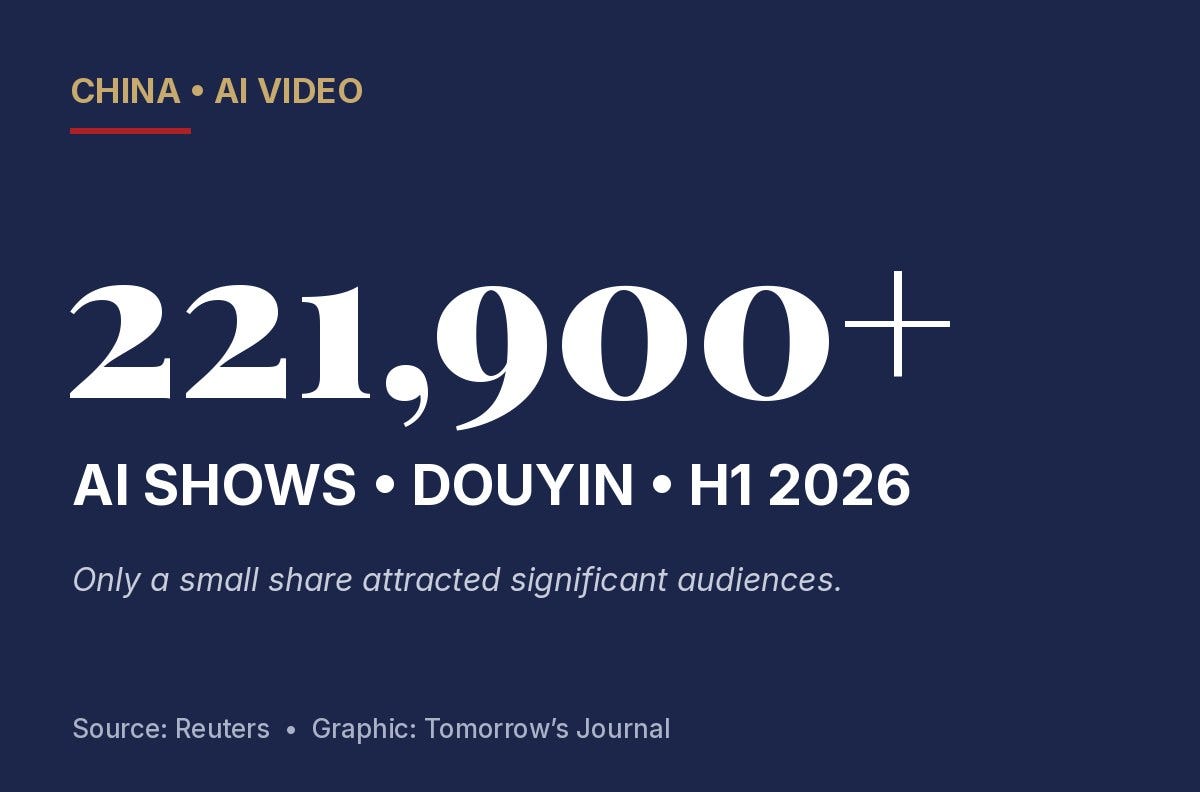
China is treating AI video as an industry, not an experiment.
Reuters reported in September that Chinese cities and industrial parks are offering subsidies, technology clusters and computing support to attract AI-content producers. More than 221,900 AI shows appeared on Douyin in the first half of 2026, although only a small share attracted significant audiences.
China’s National Film Administration has also approved Sanxingdui: Future Memories, described by Reuters as the first AI feature from a major studio approved for public release.
The economics are part of the attraction: scenes that once required sets, crews and expensive visual effects can increasingly be generated at a fraction of traditional costs.
Hollywood is therefore competing not only for physical productions and crews. It is entering a technological race over who develops the next production model — and who can turn it into an industry first.
4. ARE AUDIENCES COMING BACK?
There is one encouraging number for Hollywood: Americans are still buying movie tickets.
By late September, domestic box-office revenue had reached about $7.8 billion for 2026, according to AP, 19 percent higher than at the same point last year. One recent weekend was 58.5 percent above the comparable weekend in 2025.
But stronger ticket sales do not automatically restore Hollywood’s traditional production model. A film watched in an American theater may have been shot in another country, supported by another government’s incentives, or increasingly created with digital and AI tools that require fewer conventional production resources.
That separates two questions that once seemed almost identical: Is the movie business healthy, and is American film production healthy?
The box office suggests audiences have not abandoned theaters. The production figures show that where — and how — their movies are made remains unsettled.
THE QUESTION FOR TOMORROW
If movies can be made anywhere — and increasingly by AI — what does it mean for Hollywood to remain American?
EDITORIAL
HANS IZAAK KRIEK • EDITOR-IN-CHIEF