

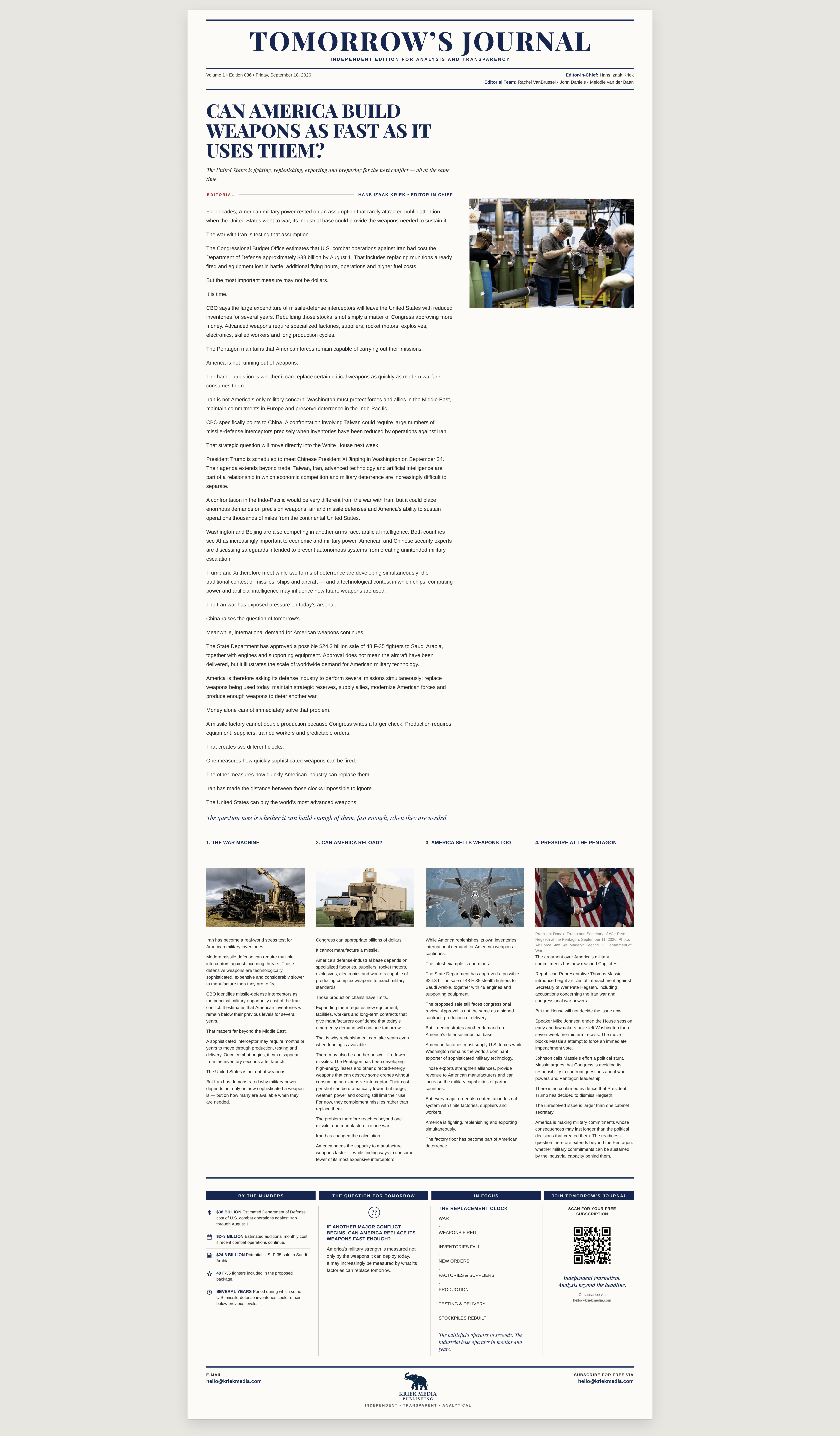
Can America Build Weapons as Fast as It Uses Them?
For decades, American military power rested on an assumption that rarely attracted public attention: when the United States went to war, its industrial base could provide the weapons needed to sustain it. The war with Iran is testing that assumption.
The Congressional Budget Office estimates that U.S. combat operations against Iran had cost the Department of Defense approximately $38 billion by August 1. That includes replacing munitions already fired and equipment lost in battle, additional flying hours, operations and higher fuel costs.
But the most important measure may not be dollars.
It is time.
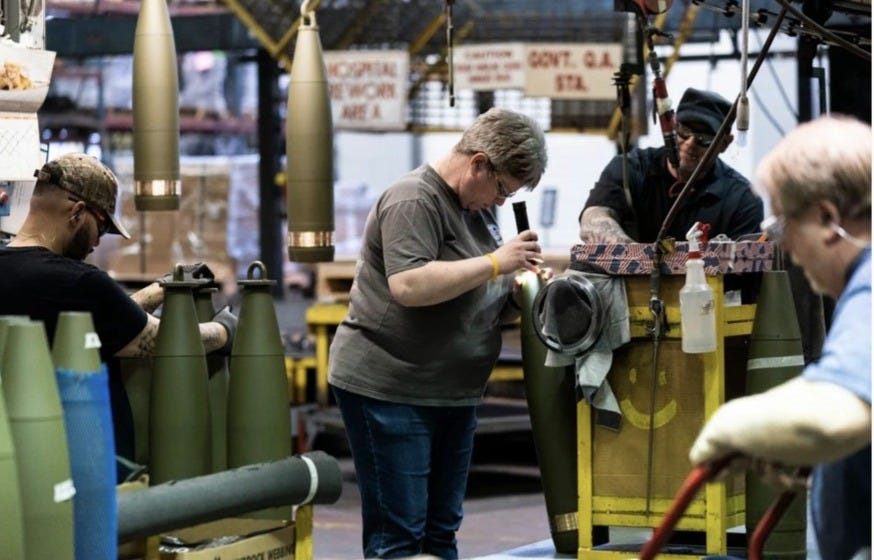
CBO says the large expenditure of missile-defense interceptors will leave the United States with reduced inventories for several years. Rebuilding those stocks is not simply a matter of Congress approving more money. Advanced weapons require specialized factories, suppliers, rocket motors, explosives, electronics, skilled workers and long production cycles.
The Pentagon maintains that American forces remain capable of carrying out their missions.
America is not running out of weapons.
The harder question is whether it can replace certain critical weapons as quickly as modern warfare consumes them.
Iran is not America’s only military concern. Washington must protect forces and allies in the Middle East, maintain commitments in Europe and preserve deterrence in the Indo-Pacific.
CBO specifically points to China. A confrontation involving Taiwan could require large numbers of missile-defense interceptors precisely when inventories have been reduced by operations against Iran.
That strategic question will move directly into the White House next week.
President Trump is scheduled to meet Chinese President Xi Jinping in Washington on September 24. Their agenda extends beyond trade. Taiwan, Iran, advanced technology and artificial intelligence are part of a relationship in which economic competition and military deterrence are increasingly difficult to separate.
A confrontation in the Indo-Pacific would be very different from the war with Iran, but it could place enormous demands on precision weapons, air and missile defenses and America’s ability to sustain operations thousands of miles from the continental United States.
Washington and Beijing are also competing in another arms race: artificial intelligence. Both countries see AI as increasingly important to economic and military power. American and Chinese security experts are discussing safeguards intended to prevent autonomous systems from creating unintended military escalation.
Trump and Xi therefore meet while two forms of deterrence are developing simultaneously: the traditional contest of missiles, ships and aircraft, and a technological contest in which chips, computing power and artificial intelligence may influence how future weapons are used.
The Iran war has exposed pressure on today’s arsenal.
China raises the question of tomorrow’s.
Meanwhile, international demand for American weapons continues.
The State Department has approved a possible $24.3 billion sale of 48 F-35 fighters to Saudi Arabia, together with engines and supporting equipment. Approval does not mean the aircraft have been delivered, but it illustrates the scale of worldwide demand for American military technology.
America is therefore asking its defense industry to perform multiple missions simultaneously: replace weapons being used today, maintain strategic reserves, supply allies, modernize American forces and produce enough weapons to deter another war.
Money alone cannot immediately solve that problem.
A missile factory cannot double production because Congress writes a larger check. Production requires equipment, suppliers, trained workers and predictable orders.
That creates two different clocks.
One measures how quickly sophisticated weapons can be fired.
The other measures how quickly American industry can replace them.
Iran has made the distance between those clocks impossible to ignore.
The United States can buy the world’s most advanced weapons.
The question now is whether it can build enough of them, fast enough, when they are needed.
THE WAR MACHINE
Iran has become a real-world stress test for American military inventories.
Modern missile defense can require multiple interceptors against incoming threats. Those defensive weapons are technologically sophisticated, expensive and considerably slower to manufacture than they are to fire.
CBO identifies missile-defense interceptors as the principal military opportunity cost of the Iran conflict. It estimates that American inventories will remain below their previous levels for several years.
That matters far beyond the Middle East.
A sophisticated interceptor may require months or years to move through production, testing and delivery. Once combat begins, it is drawn from the inventory seconds after launch.
The United States is not out of weapons.
But Iran has demonstrated why military power depends not only on how sophisticated a weapon is, but on how many are available when they are needed.
CAN AMERICA RELOAD?
Congress can appropriate billions of dollars.
It cannot manufacture a missile.
America’s defense-industrial base depends on specialized factories, suppliers, rocket motors, explosives, electronics and workers capable of producing complex weapons to exact military standards.
Those production chains have limits.
Expanding them requires new equipment, facilities, workers and long-term contracts that give manufacturers confidence that today’s emergency demand will continue tomorrow.
That is why replenishment can take years even when funding is available.
There may also be another answer: fire fewer missiles. The Pentagon has been developing high-energy lasers and other directed-energy weapons that can destroy some drones without consuming an expensive interceptor. Their cost per shot can be dramatically lower, but weather, power and cooling still limit their use. For now, they complement missiles rather than replace them.
The problem therefore reaches beyond one missile, one manufacturer or one war.
Iran has changed the calculus.
America needs the capacity to manufacture weapons faster, while finding ways to consume fewer of its most expensive interceptors.
AMERICA SELLS WEAPONS TOO
While America replenishes its own inventories, international demand for American weapons continues.
The latest example is enormous.
The State Department has approved a possible $24.3 billion sale of 48 F-35 stealth fighters to Saudi Arabia, together with engines and supporting equipment.
The proposed sale still faces congressional review. Approval is not the same as a signed contract, production or delivery.
But it demonstrates another demand on America’s defense-industrial base.
American factories must supply U.S. forces while Washington remains the world’s dominant exporter of sophisticated military technology.
Those exports strengthen alliances, provide revenue to American manufacturers and can increase the military capabilities of partner countries.
But every major order also enters an industrial system with finite factories, suppliers and workers.
America is fighting, replenishing and exporting simultaneously.
The factory floor has become part of American deterrence.
PRESSURE AT THE PENTAGON
The argument over America’s military commitments has now reached Capitol Hill.
Republican Representative Thomas Massie introduced eight articles of impeachment against Secretary of War Pete Hegseth, including accusations concerning the Iran war and congressional war powers.
But the House will not decide the issue now.
Speaker Mike Johnson ended the House session early and lawmakers have left Washington for a seven-week pre-election recess. The move blocks Massie’s attempt to force an immediate impeachment vote.
Johnson calls Massie’s effort a political stunt. Massie argues that Congress is avoiding its responsibility to confront questions about war powers and Pentagon leadership.
There is no confirmed evidence that President Trump has decided to dismiss Hegseth.
The unresolved issue is larger than one cabinet secretary.
America is making military commitments whose consequences may last longer than the political decisions that created them. The readiness question therefore extends beyond the Pentagon: whether military commitments can be sustained by the industrial capacity behind them.
BY THE NUMBERS
$38 billion: Estimated Department of Defense cost of U.S. combat operations against Iran through August 1.
$2-3 billion: Estimated additional monthly cost if recent combat operations continue.
$24.3 billion: Potential U.S. F-35 sale to Saudi Arabia.
48: F-35 fighters included in the proposed package.
Several years: Period during which some U.S. missile-defense inventories could remain below previous levels.
THE QUESTION FOR TOMORROW
IF ANOTHER MAJOR CONFLICT BEGINS, CAN AMERICA REPLACE ITS WEAPONS FAST ENOUGH?
America’s military strength is measured not only by the weapons it can deploy today. It may increasingly be measured by what its factories can replace tomorrow.
IN FOCUS
THE REPLACEMENT CLOCK
War → Weapons Fired → Inventories Fall → New Orders → Factories & Suppliers → Production → Testing & Delivery → Stockpiles Result
The battlefield operates in seconds. The industrial base operates in months and years.
JOIN TOMORROW’S JOURNAL
Independent journalism. Analysis beyond the headline.
Or subscribe via hello@kriekmedia.com